
When choosing between Breville and De’Longhi espresso machines, you’ll find distinct approaches to home brewing. Breville offers precision-engineered, feature-rich models with advanced technology and 30 grind settings, ideal for coffee enthusiasts seeking customization. De’Longhi provides budget-friendly, user-friendly machines with reliable performance and simpler operation. Your perfect machine depends on whether you prioritize intricate engineering or convenient functionality. Stick around to explore the nuanced differences that’ll guide your ultimate selection.
Key Takeaways
- Breville offers more advanced technological features like ThermoJet heating and 30 grind settings, ideal for tech-savvy coffee enthusiasts seeking precise brewing control.
- De’Longhi provides more budget-friendly espresso machines ranging from $149 to $1400, making quality home espresso accessible to cost-conscious consumers.
- Breville machines feature modern stainless steel designs with complex engineering, appealing to users who prioritize premium aesthetics and high-performance appliances.
- De’Longhi focuses on user-friendly machines with traditional designs, emphasizing ease of cleaning and operation for those wanting straightforward espresso preparation.
- The choice between Breville and De’Longhi depends on individual preferences: advanced customization and precision versus affordability and convenient functionality.
Brand Overview: Breville and De’Longhi
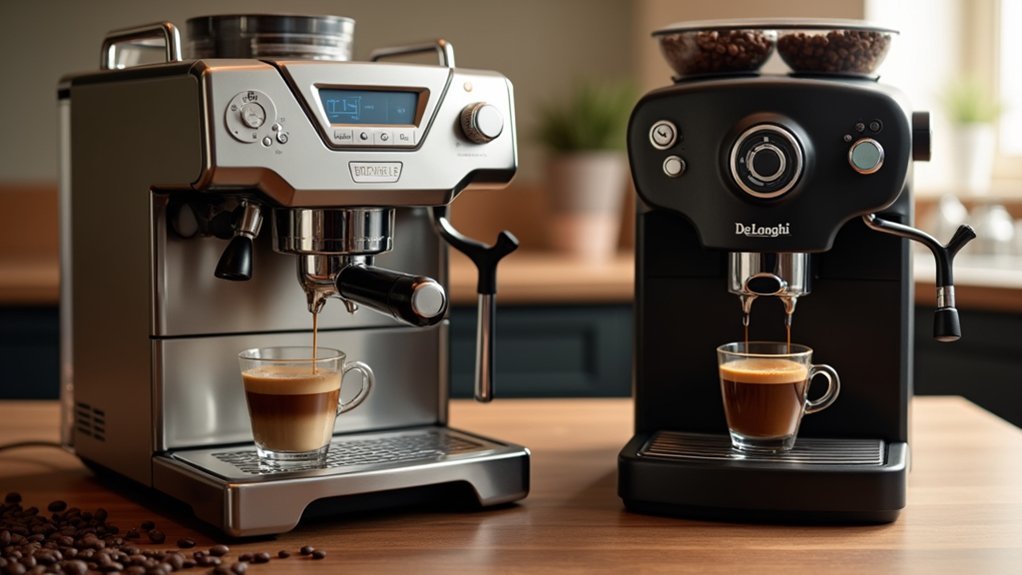
While both Breville and De’Longhi have established themselves as prominent players in the home espresso machine market, their origins and strategic approaches differ considerably. Breville, an Australian brand founded in 1932, has built a reputation for innovative, high-quality home appliances with a focus on advanced espresso machine technology. De’Longhi, originating in 1974, started as a radiator manufacturer and evolved into a respected producer of user-friendly, budget-conscious espresso machines. Their product lines reflect distinct market strategies: Breville targets coffee enthusiasts with premium, performance-driven models featuring intuitive controls, while De’Longhi caters to entry-level and mid-range consumers seeking reliable, accessible equipment. Both brands offer extensive espresso machine ranges, demonstrating their commitment to meeting diverse consumer needs through quality engineering and design.
Key Espresso Machine Specifications Compared
Building on the distinctive brand profiles of Breville and De’Longhi, a technical comparison of their espresso machine specifications reveals significant engineering differences. When choosing between these brands, you’ll want to evaluate critical specifications that impact your coffee-making experience.
| Feature | Breville | De’Longhi |
|---|---|---|
| Extraction Pressure | 9-bar | 15-bar |
| Water Tank Capacity | 64 oz | Smaller |
| Heating Technology | ThermoJet | Traditional |
| Grind Settings | 30 | 8 |
The specifications highlight nuanced trade-offs in espresso machine design. Breville offers more customization with extensive grind settings and rapid heating, while De’Longhi provides higher extraction pressure and potentially easier cleaning. Your choice depends on prioritizing precision, speed, or simplicity in your home espresso preparation.
Design and Build Quality
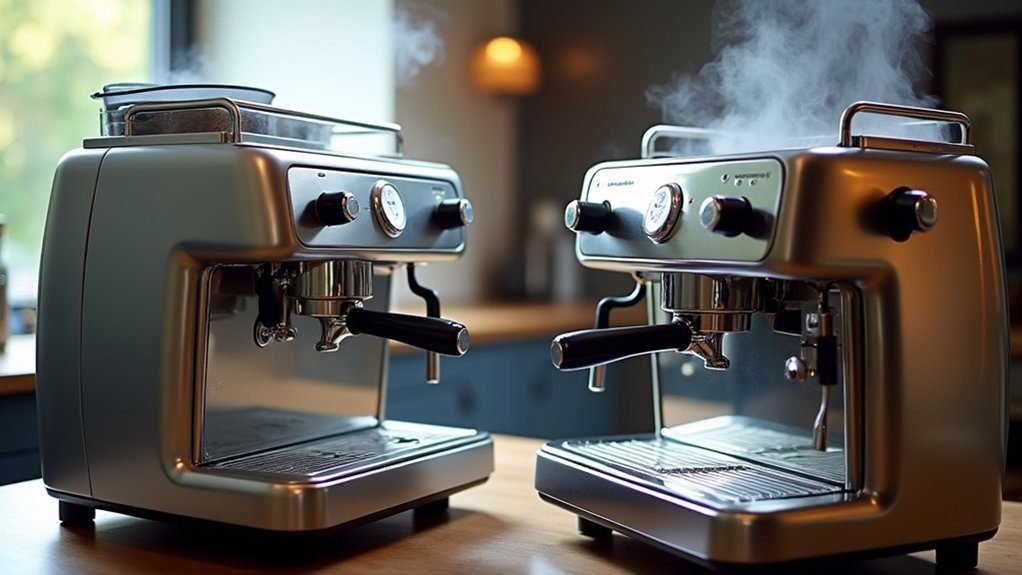
Crafted precision defines the design aesthetics of Breville and De’Longhi espresso machines, revealing distinct approaches to form and functionality. When comparing these brands, you’ll notice key differences:
- Breville machines boast modern, brushed stainless steel finishes with intuitive color touch screens
- DeLonghi espresso machines feature a retro design with traditional knobs and vintage-inspired aesthetics
- Both brands utilize high-grade materials ensuring durability and performance
- Breville’s premium models incorporate commercial-grade components for enhanced longevity
While Breville emphasizes advanced technology and sleek user-friendly operation, DeLonghi offers budget-friendly options without compromising build quality. The machines differ subtly in dimensions, with Breville’s Bambino Plus being slightly more compact than DeLonghi’s Dedica Maestro Plus. Ultimately, each brand delivers a unique blend of design sophistication and functional engineering tailored to discerning home baristas.
Performance and Brewing Capabilities
Beyond aesthetic distinctions, Breville and De’Longhi espresso machines distinguish themselves through remarkable performance metrics and brewing prowess. You’ll find notable differences in extraction pressure, with Breville’s Bambino Plus operating at 9 bars and De’Longhi’s Dedica Maestro Plus leveraging 15 bars for enhanced flavor extraction.
| Brand | Extraction Pressure | Customization |
|---|---|---|
| Breville | 9 bars | High |
| De’Longhi | 15 bars | Moderate |
| Comparative Advantage | Ease of Use | Flavor Intensity |
When brewing espresso, you’ll appreciate Breville’s ThermoJet technology enabling rapid three-minute preparation, while De’Longhi offers versatile semi-automatic and manual modes. Each machine provides unique performance characteristics: Breville emphasizes user-friendly customization, and De’Longhi focuses on robust flavor extraction, ensuring you can select an espresso machine matching your precise brewing preferences.
Milk Frothing and Steaming Features
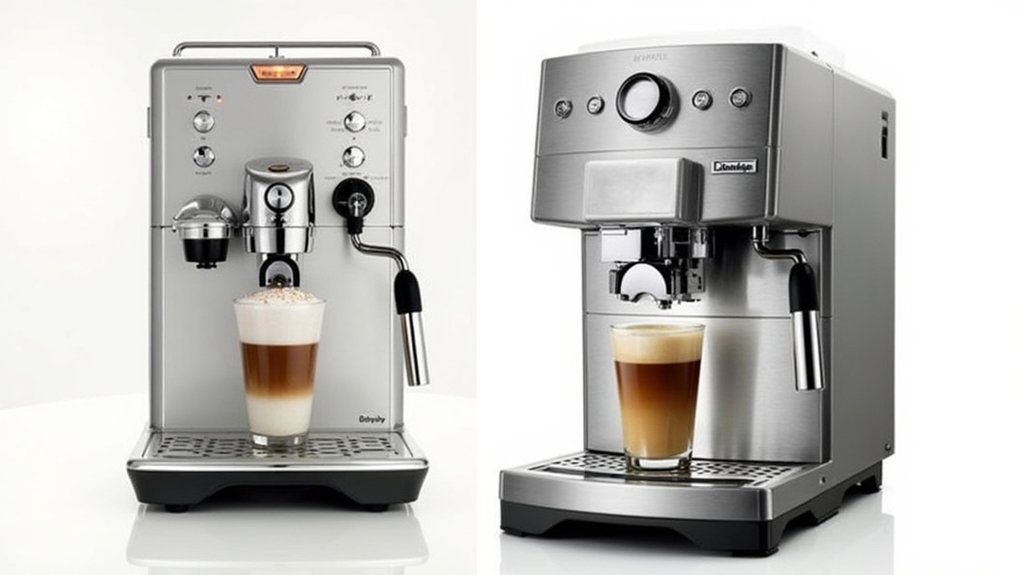
When comparing two premier espresso machine brands, milk frothing capabilities emerge as a critical differentiator between Breville and De’Longhi. Each brand offers unique features that enhance your espresso experience:
- The Breville Bambino Plus delivers a 360-degree swivel steam wand for precise microfoam creation
- De’Longhi’s Dedica Maestro Plus provides both automatic and manual milk frothing modes
- Breville’s ThermoJet technology guarantees rapid 3-minute heating with temperature consistency
- De’Longhi’s La Specialista series minimizes splatters during steam milk preparation
When you’re ready to froth milk for your espresso cups, Breville machines typically produce a creamier, caramel-colored result. De’Longhi counters with easier cleaning, offering dishwasher-safe components. Your choice depends on whether you prioritize frothing precision or convenient maintenance.
Ease of Use and User Interface
Because user interface design can profoundly impact brewing experience, the Breville and De’Longhi espresso machines demonstrate distinct approaches to ease of use. Breville’s intuitive design, exemplified by the Bambino Plus’s five front-facing control buttons, prioritizes simplicity. In contrast, De’Longhi’s Dedica Maestro Plus offers more versatility with semi-automatic and manual modes, catering to users seeking customization.
The Breville Barista Touch elevates user interaction with its digital screen, enabling precise drink personalization. Breville’s ThermoJet technology guarantees quick start-up in just three minutes, enhancing convenience. De’Longhi counters with user-friendly cleanup features like removable drip trays and dishwasher-safe components. Both brands focus on creating an accessible user interface, though their strategies differ in complexity and control options.
Price Points and Value Proposition
Although espresso machine prices can vary considerably, the Breville and De’Longhi brands offer distinct value propositions that cater to different consumer segments. Their price points reflect unique market positioning:
- Breville targets home espresso enthusiasts with machines ranging from $300 to $3699, emphasizing premium quality and advanced features
- De’Longhi provides budget-friendly options from $149 to $1400, focusing on accessibility and ease of use
- The Barista Express at $699.95 represents Breville’s high-end commitment to performance
- De’Longhi’s 15-Bar Espresso & Cappuccino Machine at $143 demonstrates affordability without compromising functionality
When selecting a home espresso machine, you’ll find that Breville prioritizes sophisticated engineering, while De’Longhi concentrates on delivering reliable, cost-effective solutions. Your choice depends on balancing technical preferences, budget constraints, and desired espresso experience.
Maintenance and Long-Term Reliability
Espresso machine reliability hinges on meticulous maintenance, with Breville and De’Longhi diverging greatly in their design philosophies toward long-term performance. You’ll find Breville’s complex components require more intensive cleaning, while DeLonghi offers more user-friendly maintenance strategies.
| Brand | Maintenance Complexity | Cleaning Ease | Component Accessibility | Long-Term Reliability |
|---|---|---|---|---|
| Breville | High | Moderate | Complex | Excellent |
| DeLonghi | Low | High | Simple | Good |
When considering long-term reliability, you’ll notice Breville’s robust construction contributes to superior performance, despite higher maintenance demands. Their machines have consistently ranked highest in brand reliability over the past decade. DeLonghi counters with simpler mechanics and dishwasher-safe parts, making routine maintenance more straightforward. Your choice depends on whether you prefer intricate engineering or streamlined design in your espresso machine investment.
Frequently Asked Questions
What Is the Best Espresso Machine for Home Use?
You’ll want an espresso machine with precise grind settings, consistent flavor extraction, user-friendly controls, and reliable milk frothing. Consider your budget, maintenance needs, and coffee preferences when selecting the perfect home brewing companion.
Which Coffee Machine Is Best for Home Use?
You’ll want an espresso machine that balances features, budget, and brewing quality. Consider your skill level, desired flavor profiles, and maintenance needs. Compare user reviews, explore different coffee bean types, and prioritize milk frothing and extraction capabilities.
What Is the Best Breville Espresso Machine for Home Use?
You’ll find the Barista Express ideal for home brewing, offering built-in grinding, user-friendly design, and consistent espresso quality. Its compact size, milk frothing capability, and moderate price make it a top choice for coffee enthusiasts seeking convenience and performance.
Is Nespresso Owned by Breville or Delonghi?
Hold onto your coffee mugs! Nespresso isn’t owned by Breville or De’Longhi; it’s a Nestlé brand. These manufacturers license the technology, producing Nespresso machines with unique design features while leveraging Nestlé’s innovative coffee pod system.
Which Espresso Machine Is Better for Brewing Strong Coffee, Breville or De’Longhi?
When deciding which espresso machine is better for brewing strong coffee, a thorough espresso machines or coffee makers comparison reveals notable differences. Breville offers advanced features and precise temperature control, while De’Longhi focuses on user-friendliness and affordability. Ultimately, personal preferences will dictate which machine excels in your kitchen.
Conclusion
When choosing between Breville and De’Longhi, imagine yourself crafting the perfect espresso—each machine a precision instrument waiting to transform your kitchen. You’ll find both brands offer exceptional quality, with subtle distinctions that can elevate your home brewing experience. Your final selection depends on personal preference, budget, and desired features. Ultimately, either choice promises barista-level performance right at your fingertips.