
If you’re monitoring twins, you’ll want a reliable baby monitor with multi-camera support. The Infant Optics DXR-8 Pro offers a stable 1,000-foot non-Wi-Fi range and connects to four cameras, while the Nanit Pro provides 1080p HD video with advanced sleep tracking. Your choice depends on whether you prioritize signal reliability or smart technology features. Stick around to uncover which monitor best suits your twin-tracking needs.
Key Takeaways
- Infant Optics DXR-8 Pro supports connections to up to four cameras, making it ideal for monitoring multiple infants simultaneously.
- Nanit Pro offers advanced sleep tracking and split-screen capabilities, providing comprehensive monitoring for twins with personalized insights.
- Infant Optics provides a stable, non-Wi-Fi signal with a 1,000-foot range, ensuring consistent video monitoring without internet dependency.
- Nanit Pro’s 1080p HD camera with superior low-light performance delivers clearer visual monitoring compared to Infant Optics’ 720p resolution.
- Consider budget constraints: Infant Optics is more cost-effective at $199, while Nanit Pro offers more advanced features at $299.
Understanding Infant Optics DXR-8 Pro Features
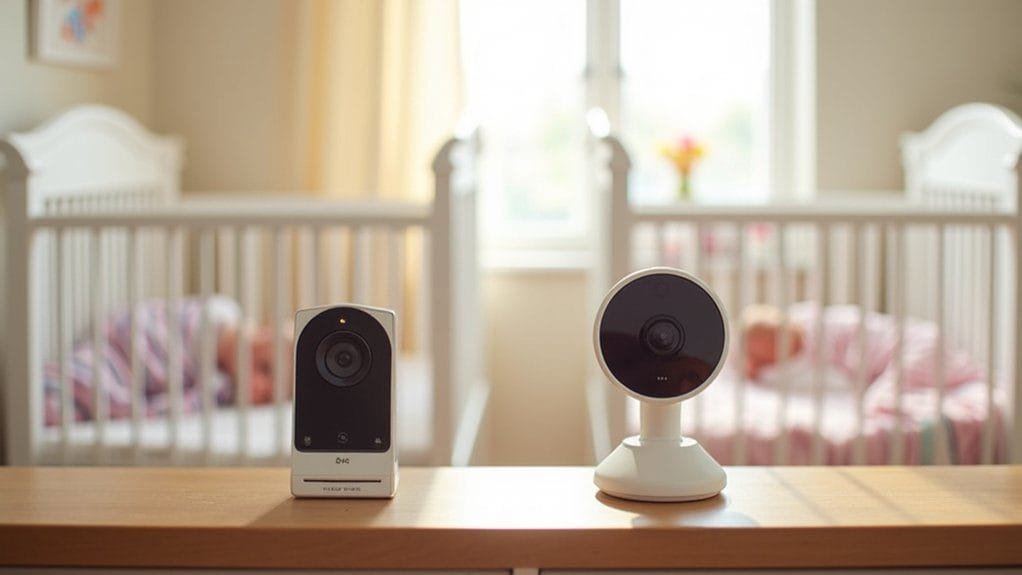
When considering a baby monitor for twins, the Infant Optics DXR-8 Pro stands out with its extensive monitoring capabilities. This non-Wi-Fi monitor delivers clear video quality through a 5-inch 720p HD display, ensuring you’ll capture every moment with precision. Its impressive range of up to 1,000 feet allows you to track your twins from virtually anywhere in your home, while supporting connections to four cameras for a truly customizable setup.
The monitor’s pan and tilt function provides versatile viewing angles, essential for keeping an eye on two active infants. Enhanced sound quality and noise-reduction technology guarantee you’ll hear every whimper and giggle, even in noisy environments. With these features, the Infant Optics DXR-8 Pro becomes an indispensable tool for parents of twins.
Exploring Nanit Pro Smart Baby Monitor Capabilities
Because modern parents demand cutting-edge technology, the Nanit Pro Smart Baby Monitor emerges as a sophisticated solution for tracking infant development. You’ll appreciate its robust features designed specifically for twin monitoring:
| Feature | Benefit | Technology |
|---|---|---|
| 1080p HD Camera | Clear visual monitoring | High-resolution streaming |
| Advanced Sleep Tracking | Personalized insights | Developmental pattern analysis |
| Secure Encryption | Privacy protection | 256-bit AES authentication |
| Multiple Camera Support | Room-wide monitoring | Flexible placement options |
| Smart Home Integration | Remote accessibility | Smartphone app connectivity |
The Nanit Pro delivers thorough infant surveillance through its sleep tracking capabilities and secure connection. You’ll gain advanced sleep insights while maintaining complete privacy. Its smart home integration allows remote access, ensuring you’re always connected to your twins’ environment, making it an invaluable tool for modern parenting.
Comparing Camera Quality and Resolution
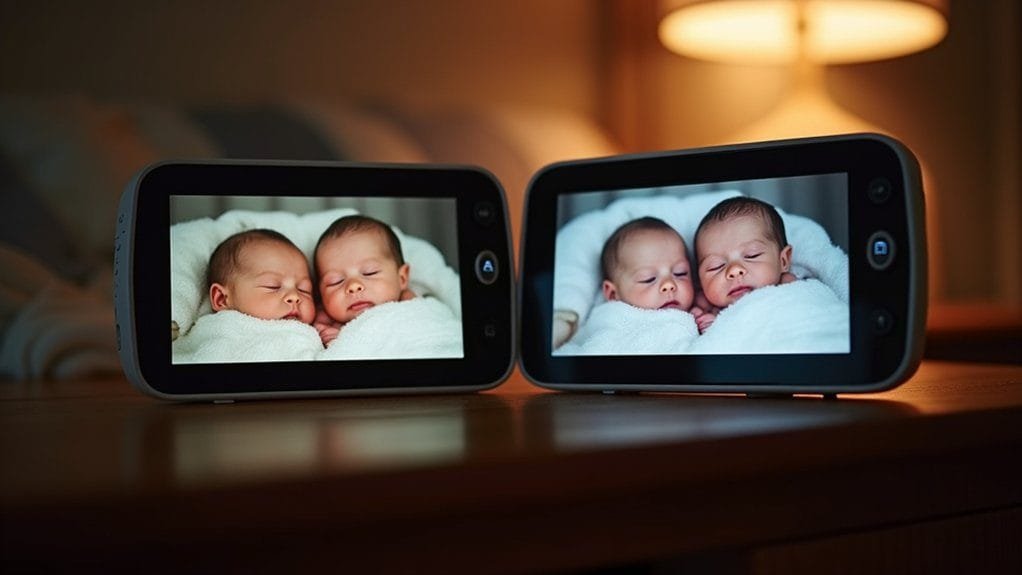
Camera quality stands as a paramount consideration for parents seeking the ideal baby monitor for twins. When comparing the Infant Optics DXR-8 Pro and Nanit Pro, resolution differences become immediately apparent. The Infant Optics offers a 720p HD video feed, while the Nanit Pro delivers a superior 1080p HD experience, ensuring clearer visual monitoring of your little ones.
Night vision capabilities further distinguish these monitors. The Nanit Pro’s advanced features provide exceptional low-light performance, critical for continuous twin monitoring. While the Infant Optics provides decent video quality, the Nanit Pro’s split-screen capability allows simultaneous viewing of multiple angles, enhancing your ability to track both babies effectively.
Sound detection and clear audio complement these visual technologies, making your monitoring experience thorough and reassuring.
Analyzing Monitoring Range and Signal Strength
Though signal strength and monitoring range can make or break your twin baby monitoring experience, the Infant Optics DXR-8 Pro and Nanit Pro demonstrate distinct technological approaches to maintaining a reliable connection. The Infant Optics offers a robust non-Wi-Fi baby monitor with a 1,000-foot range, allowing seamless monitoring across multiple areas without interference. In contrast, the Nanit Pro relies on Wi-Fi connectivity, which can introduce potential video transmission latency and signal variability.
When tracking twins, you’ll appreciate the Infant Optics’ ability to add up to four cameras while maintaining strong, real-time video signals. The Nanit Pro’s performance hinges on your home’s internet quality, potentially compromising consistent monitoring. Your choice depends on prioritizing stable signal strength or remote accessibility.
Evaluating Split-Screen and Dual Monitoring Performance
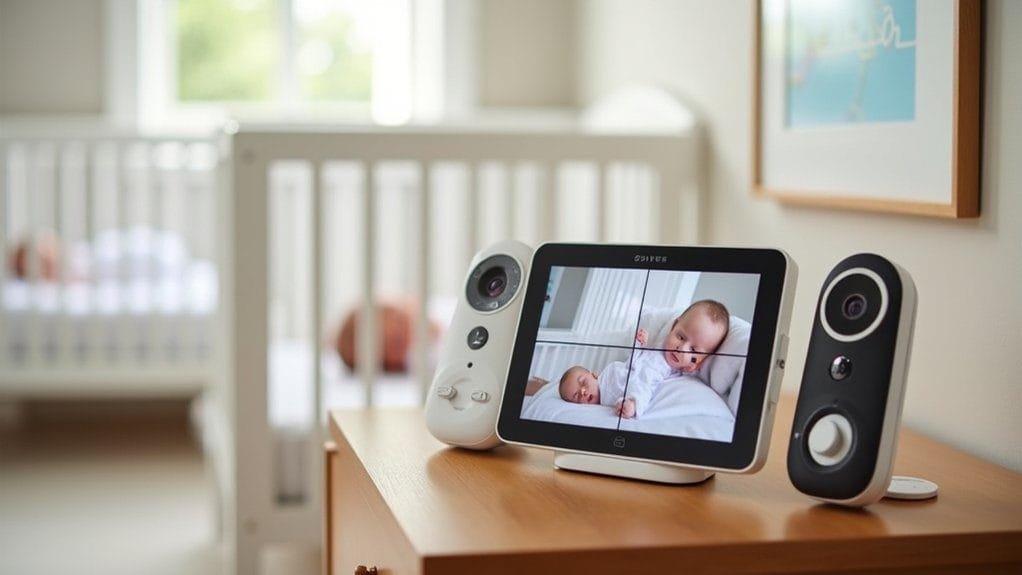
For parents of twins, split-screen monitoring represents a critical feature that can greatly streamline childcare management. When evaluating performance for monitoring twins, several baby monitors demonstrate unique capabilities:
- The Nanit Pro Smart Baby Monitor offers advanced app-based split-screen viewing, enabling simultaneous observation of both infants
- Babysense Max View provides a dedicated 5.5-inch HD display specifically designed for dual-camera setups
- The Vava Split View Baby Monitor delivers real-time split-screen functionality for thorough monitoring
- Infant Optics DXR-8 Pro supports multiple cameras but lacks native split-screen capabilities
While each monitor offers distinct approaches to dual monitoring, parents must prioritize reliable connectivity, video feed quality, and seamless performance. The key is selecting a baby monitor that provides clear, synchronized visibility across both infant environments, ensuring thorough and stress-free monitoring of twins.
Assessing Connectivity and Smart Technology Options
How critical are connectivity and smart technology when choosing a baby monitor for twins? When evaluating the Infant Optics DXR-8 Pro and Nanit Pro, parents must weigh secure connection against advanced features. The Infant Optics offers a reliable, non-Wi-Fi system with up to 1,000 feet of range, ensuring uninterrupted video monitoring without internet dependency. Conversely, the Nanit Pro delivers robust smart technology, including sleep insights and breathing motion tracking, accessible through smartphone remote access. While the Nanit Pro provides encrypted video and developmental tracking, the Infant Optics prioritizes direct, secure communication. Your choice ultimately depends on whether you value traditional reliability or cutting-edge technological monitoring for your twins, balancing connectivity needs with thorough baby surveillance capabilities.
Breaking Down Cost and Value Considerations
Connectivity and smart technology set the stage for understanding the financial investment required when selecting a baby monitor for twins. When comparing the Infant Optics and Nanit Pro, you’ll discover nuanced cost-value considerations:
- The Infant Optics DXR-8 Pro offers budget-friendly dual-camera monitoring at $199
- Nanit Pro provides advanced sleep tracking and encrypted video for $299
- Upfront costs differ, but long-term value depends on extensive features
- Total ownership expenses include potential subscription fees for app functionality
Your decision hinges on balancing immediate budget constraints with desired monitoring capabilities. The Infant Optics model delivers reliable, non-Wi-Fi monitoring, while the Nanit Pro appeals to tech-savvy parents seeking detailed sleep analytics and remote access. Ultimately, your choice should align with your family’s specific monitoring needs and financial considerations.
Parent User Experience and Reliability Ratings
When evaluating baby monitors for twins, parents prioritize reliability and user experience as critical factors in their decision-making process. The Infant Optics DXR-8 Pro stands out with exceptional sound quality and straightforward setup, offering parents a non-Wi-Fi solution that’s easy to use. In contrast, the Nanit Pro Smart Baby Monitor provides advanced features like thorough sleep tracking, though some users report occasional connectivity challenges.
User reviews reveal distinct strengths for each monitor. The Infant Optics model boasts long battery life and consistent performance across its 1,000-foot range, while the Nanit Pro impresses with its detailed 1080p HD video and sophisticated app. Your choice will depend on whether you’re seeking reliable simplicity or cutting-edge monitoring technology for your twins.
Frequently Asked Questions
What Is the Best Baby Monitor for Twins?
You’ll want a twin baby monitor with split-screen capabilities, like the Babysense Max View, offering high video quality, smart features, and reliable audio clarity. Consider your budget and tech needs when comparing top-rated models for thorough infant monitoring.
Is Nanit Good for Twins?
Nanit’s split-screen feature and wall-mount design make it excellent for twins. You’ll appreciate its sleep tracking, breathing monitoring, and high-quality app functionality. While pricey, its extensive features and twin-specific capabilities offer valuable developmental insights for parents.
What Is the Number One Recommended Baby Monitor?
You’re worried about finding the perfect baby monitor? The Nanit Pro leads with superior video quality, robust wireless connectivity, and an intuitive app, offering extensive features that parents trust for monitoring their little ones effectively and securely.
Can Infant Optics Do Split Screen?
No, the Infant Optics DXR-8 Pro doesn’t support true split-screen functionality. You’ll need to manually cycle through cameras, which takes up to 15 seconds, making simultaneous twin monitoring challenging compared to dedicated split-screen baby monitors.
Do Baby Monitors Help New Parents Keep an Eye on Twins with Products Like Infant Optics and Nanit?
Baby monitors for peace of mind are essential for new parents managing twins. Products like Infant Optics and Nanit offer advanced features, allowing parents to monitor both babies simultaneously. With crystal-clear video and audio, these monitors ensure that parents can effortlessly keep an eye on their little ones, even from another room.
Conclusion
When comparing Infant Optics and Nanit for twins, you’ll discover each monitor offers unique strengths. Coincidentally, as you research, you’ll realize the perfect solution depends on your specific parenting needs. Whether prioritizing budget-friendly reliability or advanced smart tracking, both systems guarantee your babies’ safety. Trust your instincts, weigh the evidence, and choose the monitor that’ll give you peace of mind during those precious early years.