
When comparing under-desk bikes and treadmills, you’ll find treadmills burn more calories—approximately 295 calories in 30 minutes versus a bike’s 210 calories. The key difference lies in muscle engagement: treadmills activate more muscle groups through weight-bearing movements, increasing metabolic impact. Your workout intensity matters, but treadmills inherently provide superior calorie expenditure. Curious about how these options stack up for your specific fitness goals? Uncover the nuanced insights ahead.
Key Takeaways
- Treadmills generally burn more calories, with approximately 295 calories in 30 minutes compared to 210 calories for under-desk bikes.
- Calorie expenditure depends on workout intensity, with vigorous pedaling on bikes potentially matching moderate treadmill walking.
- Treadmills engage more muscle groups through weight-bearing movements, leading to higher overall energy expenditure and calorie burn.
- Running and increasing treadmill incline can significantly boost calorie burning potential compared to standard under-desk bike usage.
- Individual factors like body weight, workout duration, and personal exertion level ultimately determine the precise calorie-burning difference between bikes and treadmills.
Calorie-Burning Potential Breakdown

When it comes to workplace fitness equipment, calorie burn is a critical metric for health-conscious professionals. Your choice between a treadmill and a stationary bike notably impacts exercise efficiency. A 125-pound individual burns approximately 210 calories on an under-desk bike versus 295 calories on a treadmill during a 30-minute workout, demonstrating the treadmill’s superior calorie-burning potential. Research indicates stationary bikes burn 478-628 calories per hour, while treadmills generate 490-646 calories, highlighting minimal differences at high-intensity levels. Your workout’s effectiveness depends on maintaining consistent intensity and duration. Treadmills offer more versatility through incline adjustments and running options, enabling higher calorie expenditure. While both fitness machines provide cardiovascular benefits, the treadmill emerges as the more potent tool for maximizing calorie burn during workplace exercise sessions.
Intensity and Duration Factors
While calorie burn varies across fitness equipment, the intensity and duration of your workout fundamentally determine its metabolic impact. The calories you burn depend directly on how vigorously you work out anytime you choose stationary bikes or treadmills. Increasing the intensity means higher energy expenditure; for instance, vigorous pedaling can outperform moderate treadmill walking in burning calories.
Your cardiovascular health benefits from strategic workout design. By increasing the resistance on bikes or adjusting treadmill inclines, you’ll enhance calorie expenditure. Duration matters equally—longer sessions consistently translate to more substantial metabolic engagement. High-intensity intervals prove particularly effective, dramatically elevating the potential calories burned across both treadmill vs under-desk bike platforms.
The key is purposeful, progressive exercise that challenges your physiological limits.
Muscle Engagement and Energy Expenditure
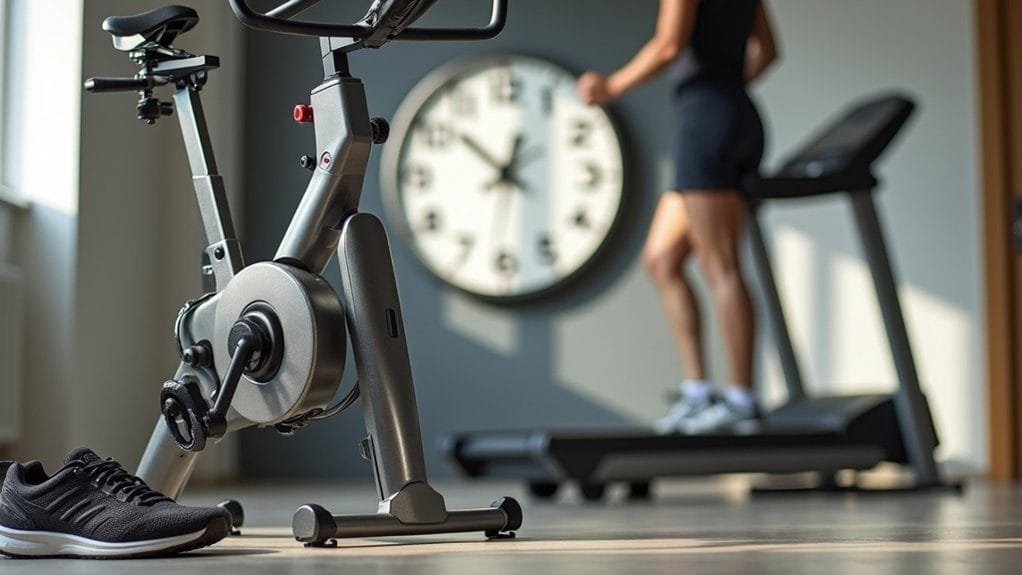
Although treadmills and under-desk bikes target similar lower-body muscle groups, their energy expenditure mechanisms differ considerably. When you’re aiming to burn more calories, the treadmill’s weight-bearing nature engages more muscle groups, increasing overall energy expenditure. This leads to a more substantial calorie deficit compared to low-impact exercise on an under-desk bike.
Running activates core and upper body muscles simultaneously, making it a more thorough cardio equipment option for weight loss. The dynamic movement requires greater physical activity, which translates to higher metabolic demand. By contrast, stationary cycling primarily focuses on leg muscles, limiting total muscle recruitment. While both improve cardiovascular fitness, the treadmill’s full-body engagement guarantees more efficient energy expenditure, making it the superior choice for those seeking maximum caloric burn.
Low-Impact vs. High-Impact Movement
Because joint health plays a critical role in long-term fitness sustainability, understanding the biomechanical differences between low-impact and high-impact movement becomes essential for individuals selecting exercise equipment. Under-desk bikes offer a low-impact workout that minimizes stress on joints while providing cardiovascular health benefits. In contrast, treadmills represent a high-impact option that can burn more calories but potentially strain knee and ankle structures. When comparing these options, you’ll find that under-desk bikes allow for gentler muscle engagement, burning approximately 210 calories in 30 minutes, while treadmills can expend up to 295 calories during the same period. The intensity of your workout directly influences caloric expenditure, with under-desk bikes providing a more joint-friendly alternative to traditional high-impact exercise modalities.
Workspace Considerations
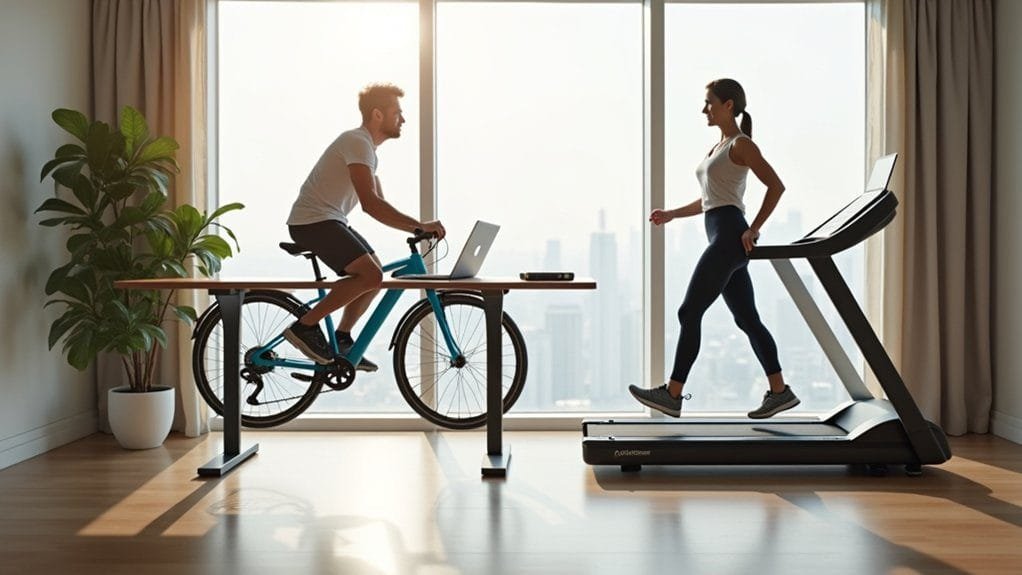
Every workspace presents unique spatial challenges when integrating active fitness equipment, and the choice between under-desk bikes and treadmills demands careful dimensional analysis. Under-desk bikes offer superior compactness, easily sliding beneath standard office desks with minimal disruption. Treadmills, conversely, require substantially more floor space, potentially constraining workplace functionality.
Noise considerations further differentiate these fitness solutions. Under-desk bikes generate minimal acoustic interference, supporting concentrated work environments, while treadmills can produce disruptive operational sounds. Ergonomic alignment remains critical; precise desk height adjustments guarantee ideal biomechanical positioning for both equipment types.
When evaluating workspace integration, under-desk bikes demonstrate clear advantages in spatial efficiency, acoustic performance, and adaptability across diverse office configurations. Your selection should prioritize workplace dynamics and available square footage.
Cost and Accessibility
One key differentiator between under-desk bikes and treadmills lies in their financial accessibility and overall cost structure. Budget-conscious consumers will find under-desk bikes considerably more affordable, with entry-level models starting around $200, compared to treadmills requiring a higher initial investment. These compact devices offer a cost-effective solution for incorporating physical activity into your workspace without substantial financial commitment.
Operational costs further distinguish these fitness tools. Under-desk bikes consume minimal electricity, making them an economical long-term choice. Their space-efficient design allows seamless integration into smaller work environments, reducing both spatial and financial barriers. When evaluating accessibility, under-desk bikes demonstrate a clear advantage, providing an affordable, low-investment option for individuals seeking convenient workplace exercise solutions.
Personal Fitness Goals Alignment
When aligning personal fitness goals with workplace exercise equipment, individuals must carefully evaluate the performance metrics of under-desk bikes and treadmills.
Consider these key factors:
- Calorie Burn: Treadmills outperform under-desk bikes, burning approximately 85 more calories per 30-minute session, making them superior for weight loss objectives.
- Workout Intensity: Treadmills offer versatile incline adjustments, enabling higher-intensity cardio workouts compared to the typically lower-intensity bike options.
- Physical Constraints: Under-desk bikes provide a low-impact alternative for individuals with joint limitations, ensuring consistent, gentle movement without excessive strain.
Your choice between bike and treadmill depends on specific personal fitness goals. Treadmills excel in rapid calorie expenditure, while under-desk bikes offer consistent, adaptable movement. Evaluating your fitness priorities, physical condition, and desired workout intensity will guide your ideal cardio machine selection.
Health Benefits Comparison
Metabolic efficiency sits at the core of comparing health benefits between under-desk bikes and treadmills. When you’re seeking to optimize your work-based exercise, understanding the comparative health impacts becomes essential. Both under-desk bikes and treadmills offer unique cardiovascular advantages, with distinct calorie-burning potentials.
| Feature | Under-Desk Bikes | Treadmills |
|---|---|---|
| Calories Burned | 400-600/day | 600-800/day |
| Joint Impact | Low-impact | Moderate-impact |
| Muscle Engagement | Lower body | Full body |
| Fitness Intensity | Moderate | High |
Your choice depends on individual fitness goals, joint health, and workplace constraints. Under-desk bikes provide a low-impact exercise solution, while treadmills offer more extensive full-body movement. Both contribute to improved cardiovascular health and can mitigate sedentary work risks when integrated strategically into your daily routine.
Making the Right Choice for Your Lifestyle
Because individual lifestyle factors considerably influence exercise equipment selection, your choice between an under-desk bike and treadmill hinges on several critical ergonomic and productivity metrics.
Consider these key decision points:
- Workout Intensity: Under-desk bikes offer low-impact exercise, while treadmills support higher-intensity cardio, enabling you to burn more calories based on your personal fitness goals.
- Multitasking Capability: Assess how comfortably you can perform work tasks while exercising. Bikes typically allow more seamless integration with professional activities compared to treadmills.
- Space Availability: Evaluate your workspace dimensions, as under-desk bikes generally require less room and provide more flexible positioning than treadmills.
Ultimately, selecting equipment that aligns with your specific lifestyle will help you consistently improve health through active workplace strategies.
Frequently Asked Questions
Is an Under Desk Bike or Treadmill Better?
You’ll find treadmills more effective for desk exercise, offering higher calorie comparison and workout efficiency, especially if you’re combating a sedentary lifestyle with fitness technology that prioritizes health benefits and productivity boost.
Is the Bike or Treadmill Better for Weight Loss?
You’ll torch more calories on a treadmill, but a bike’s lower-impact design matters. Consider your fitness goals, exercise intensity, and personal preference—both effectively support weight loss when used consistently with proper heart rate targeting.
Do Under Desk Bikes Really Burn Calories?
You’ll burn calories with under-desk bikes, but caloric expenditure depends on your fitness levels, exercise intensity, and duration. While muscle engagement varies, they’re a convenient, low-impact option that can modestly boost heart rate and support weight management.
Which Burns More Calories, Cycling or Treadmill?
Pedaling or striding, you’ll find treadmills torch more calories through higher exercise intensity. Your caloric expenditure depends on workout duration, muscle engagement, and individual fitness goals, with running typically outpacing cycling in energy burn.
Conclusion
When choosing between under-desk bikes and treadmills, you’ll need to weigh your specific fitness objectives. While both offer movement opportunities, treadmills typically burn more calories per hour. Don’t put all your eggs in one basket—consider your workspace constraints, budget, and individual health goals. Ultimately, the most effective option is the one you’ll consistently use, integrating seamlessly into your daily workflow and maintaining long-term physical activity.