
You’ll find WalkingPad and LifeSpan offer distinct compact desk treadmill solutions. WalkingPad provides budget-friendly portability at $300-$600, supporting 220 lbs with speeds up to 4 mph. LifeSpan delivers superior durability with a 10-year warranty, 350 lbs capacity, and Bluetooth connectivity, priced around $1,300. Your choice depends on prioritizing affordability or long-term performance. Stick around to unpack the nuanced trade-offs that’ll guide your ideal workspace fitness investment.
Key Takeaways
- The LifeSpan TR1200-DT3 offers superior long-term value with a 10-year warranty and robust 2.25 HP motor, despite higher initial cost.
- WalkingPad provides a budget-friendly, ultra-portable option with lightweight design and foot-controlled speed adjustments for compact workspace integration.
- LifeSpan supports higher user weight capacity (350 lbs) and includes integrated stability features, making it more suitable for diverse users.
- WalkingPad is ideal for minimalist spaces with its slim 5-inch profile and lightweight 55 lbs construction, enabling easy storage.
- Performance-wise, both treadmills offer similar walking speeds (0.4-4.0 MPH), but LifeSpan provides more advanced connectivity and user features.
What Makes a Compact Desk Treadmill Great
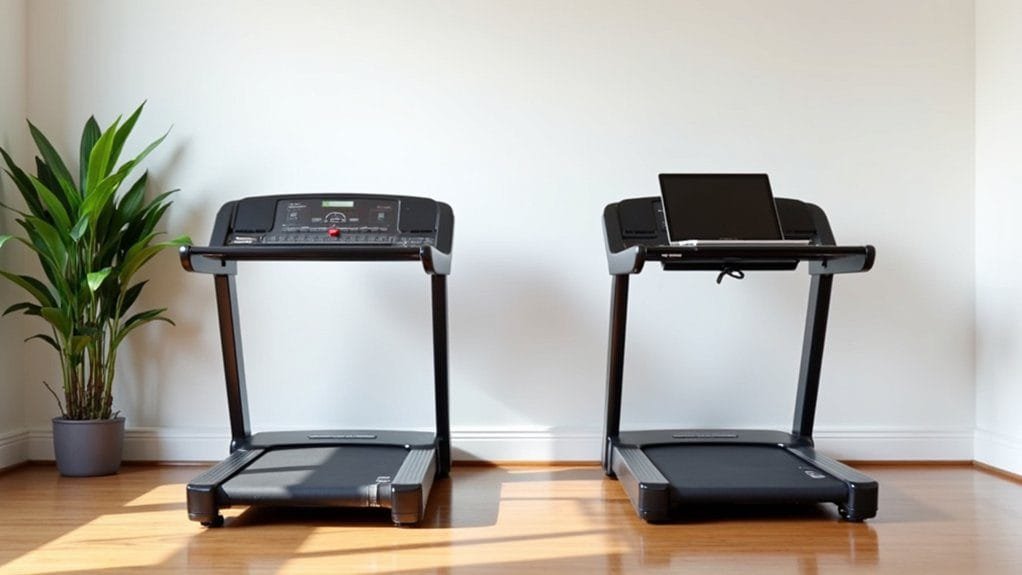
Space-saving innovation meets productivity in the domain of compact desk treadmills. These devices like WalkingPad and LifeSpan transform home office environments by integrating seamless fitness opportunities into workspace design. Their foldable design enables convenient storage, while quiet operation guarantees minimal disruption during work sessions.
Critical technical considerations define their effectiveness: weight capacity and speed range directly impact usability. Most compact desk treadmills support users up to 220 lbs and provide walking speeds maxing around 4 mph. This makes them ideal for maintaining daily activity without compromising professional workflow. Users can incrementally improve fitness levels by integrating walking into sedentary work routines, effectively converting potential idle time into purposeful movement. The strategic combination of ergonomic design and functional mobility characterizes these innovative fitness solutions.
Performance Breakdown: WalkingPad and LifeSpan Compared
While compact desk treadmills revolutionize home office fitness, the WalkingPad P1 and LifeSpan TR1200-DT3 represent distinct approaches to integrated exercise technology. Their performance diverges across key metrics that’ll impact your workout experience.
| Feature | WalkingPad P1 | LifeSpan TR1200-DT3 |
|---|---|---|
| Speed Range | 0.5-4.0 MPH | 0.4-4.0 MPH |
| Weight Capacity | 220 lbs | 350 lbs |
| Connectivity | Limited | Bluetooth Enabled |
The WalkingPad’s compact design (21.5 x 56.4 x 5 inches) offers superior storage with its foldable structure, while the LifeSpan provides a more robust frame and higher weight capacity. Though both deliver similar speed ranges, the LifeSpan distinguishes itself through Bluetooth tracking and an extensive 10-year warranty, giving it a technical edge in the compact treadmill market.
Pricing and Value Considerations
When comparing the WalkingPad and LifeSpan treadmills, pricing emerges as a critical factor that greatly impacts purchasing decisions for home office fitness solutions. WalkingPads offer a budget-friendly range of $300 to $600, appealing to cost-conscious consumers seeking compact treadmill options. Conversely, LifeSpan’s models, like the TR1200-DT3, command a higher price point around $1,300, reflecting superior build quality and extensive warranty coverage.
Your investment considerations should extend beyond initial cost. LifeSpan’s robust 10-year frame and 2-year motor warranty considerably outweigh WalkingPad’s limited 30-day coverage. While WalkingPads provide an economical entry point, serious fitness enthusiasts might find greater long-term value in LifeSpan’s durability and advanced features, making the higher upfront investment more justifiable for a reliable compact treadmill.
Design and Portability Features
Because compact design and portability represent critical differentiators in home office fitness equipment, the WalkingPad and LifeSpan treadmills showcase markedly divergent approaches to spatial efficiency. The WalkingPad’s ultra-compact dimensions (21.5 x 56.4 x 5 inches) and lightweight 55-lb construction enable unprecedented storage flexibility, easily sliding under desks or into tight spaces. Conversely, LifeSpan’s models, while larger (63 x 28 x 7 inches), feature EZfold™ technology for straightforward storage. Key design distinctions emerge in user preferences: WalkingPad’s minimalistic approach eliminates handrails, prioritizing compact design, while LifeSpan emphasizes stability through integrated support structures. These contrasting portability strategies reflect nuanced engineering choices, allowing users to select equipment aligned with their spatial constraints and workout requirements.
User Experience and Real-World Performance
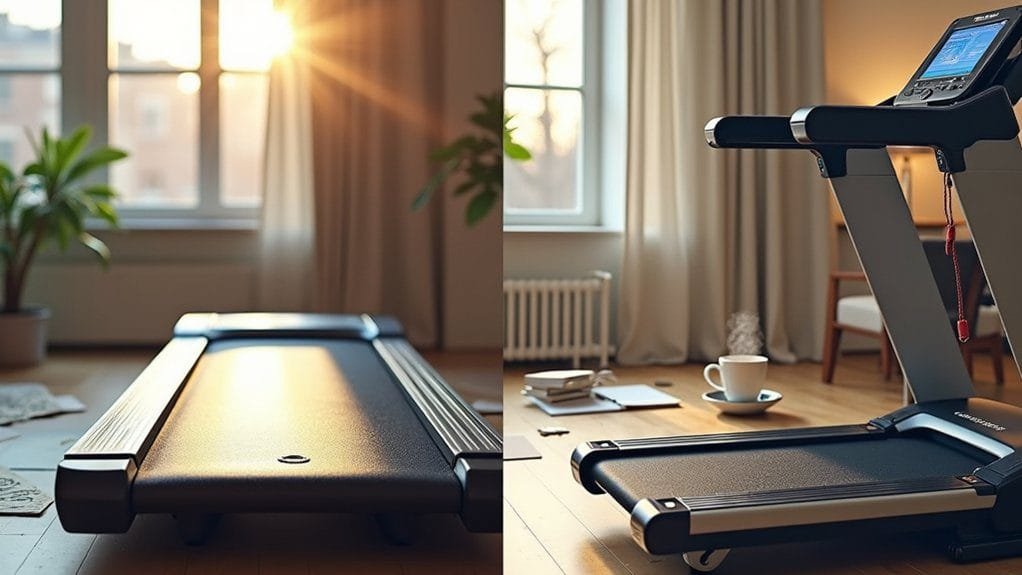
Design considerations seamlessly cascade into performance evaluations, revealing how spatial engineering translates to real-world user experiences. When comparing the WalkingPad and LifeSpan treadmills, you’ll find distinct performance profiles that align with their compact design philosophies. The WalkingPad P1 delivers a nimble, user-friendly experience with foot-controlled speed adjustments, ideal for lightweight, portable treadmill solutions. Conversely, the LifeSpan TR1200-GlowUp offers superior durability through its robust 2.25 HP motor and expanded weight capacity of 330 lbs. Its ultra-quiet operation guarantees minimal workplace disruption, making it a premier choice for professionals seeking uninterrupted productivity. While the WalkingPad excels in portability, the LifeSpan prioritizes performance and long-term reliability, providing users with a thorough treadmill solution tailored to varied workspace demands.
Frequently Asked Questions
Which Is Better, a Treadmill or a Walking Pad?
You’ll find treadmills offer more intense workouts and features, while walking pads excel in portability and space-saving design. Your choice depends on exercise goals, budget, noise tolerance, and specific health and fitness preferences.
Which Is the Best Under Desk Treadmill?
Like a sleek tiger ready to prowl, the best under desk treadmill balances compact design, safety, and performance. Consider user weight, noise levels, warranty, and fitness productivity when selecting your ideal space-saving walking pad for seamless office exercise.
Is It Worth Getting a Walkingpad?
You’ll find a WalkingPad worth it if you prioritize health benefits, space efficiency, and productivity boost. Its affordable price, quiet operation, and portability make it an attractive option for achieving daily step goals without compromising workspace or comfort.
Are Walking Pads Better Than Treadmills for Elderly People?
Walking pads offer seniors safer, low-impact exercise with adjustable speeds and compact design. They’re easier to use, store, and maneuver. However, individual stability needs and balance concerns should be carefully evaluated before selecting between walking pads and traditional treadmills.
Conclusion
When it comes to compact desk treadmills, you’ve got two titans that hit the nail on the head. WalkingPad and LifeSpan each bring unique strengths to the home office fitness arena. Your choice depends on specific needs: budget constraints, space limitations, and personal walking preferences. Both models represent cutting-edge solutions for integrating movement into sedentary work environments, offering innovative approaches to maintaining health without sacrificing productivity.