
If you’re seeking the ultimate smart ceiling fan for large rooms, you’ll find Haiku and Hunter offer compelling options. Haiku leads with advanced sensor technology and a premium price point, delivering intelligent climate control. Hunter provides budget-friendly alternatives with reliable performance and solid smart home integration. Both brands excel in airflow efficiency, offering 5,000+ CFM and Wi-Fi connectivity. Keep exploring to uncover which fan perfectly matches your specific cooling needs.
Key Takeaways
- Hunter offers budget-friendly smart ceiling fans with reliable performance and basic smart home integration, ideal for cost-conscious consumers seeking large room cooling.
- Haiku provides advanced smart ceiling fan technology with superior motion sensors, natural breeze simulation, and comprehensive mobile app control for tech-enthusiasts.
- For large rooms, both brands offer fans with blade spans of 52-62 inches and airflow capabilities exceeding 5,000 CFM, ensuring effective cooling performance.
- Hunter fans are more economically priced (under $400) with standard features like voice control and reversible motors, suitable for straightforward smart home setups.
- Haiku fans deliver premium features at higher price points ($450-$1,600), targeting homeowners prioritizing intelligent climate management and sophisticated technological integration.
Understanding Smart Ceiling Fan Technology
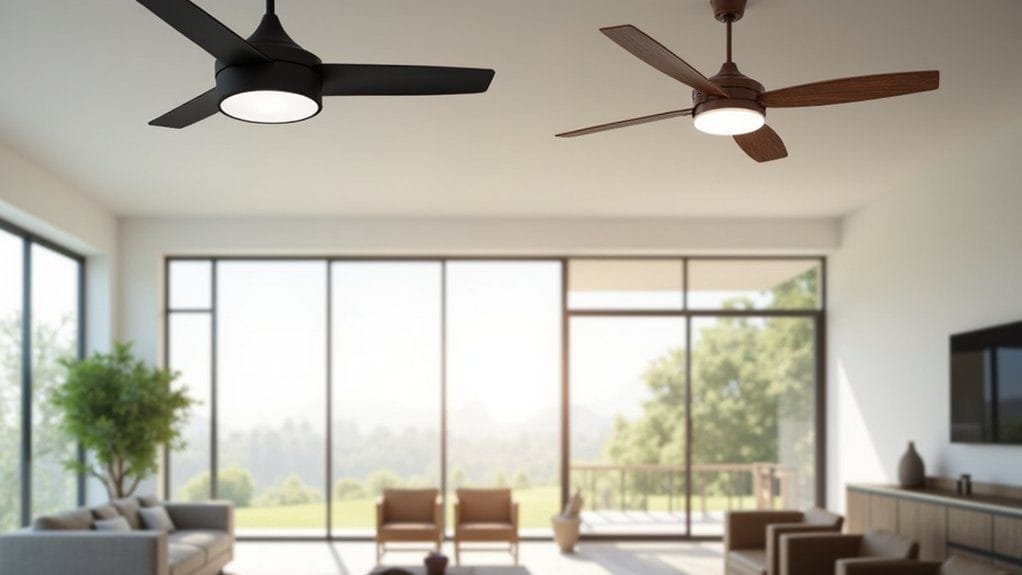
As smart home technology continues to evolve, ceiling fans have undergone a significant technological transformation. Smart ceiling fans now offer advanced capabilities that let you control the fan through smartphone apps and voice control systems. These innovative devices enhance air around your living spaces by adjusting fan speed and integrating with smart home ecosystems like Alexa and Google Assistant.
The technology focuses on energy efficiency and user convenience. Motion sensors can detect room occupancy, automatically modulating airflow to maintain ideal comfort. Wi-Fi connectivity enables precise remote management, while sophisticated apps provide extensive control options. Professional installation guarantees these high-tech fans are set up correctly, maximizing their performance and technological potential in large room environments.
Key Performance Metrics for Large Room Cooling
Smart ceiling fan technology demands rigorous evaluation through specific performance metrics, particularly when cooling large rooms. You’ll want to focus on key indicators like CFM, which measures airflow volume, and blade span, critical for thorough cooling performance. A fan with 5,000+ CFM guarantees effective air circulation in expansive spaces, while a 52-62 inch blade span maximizes coverage.
When examining smart features, prioritize energy-efficient motors and customizable speed settings. Haiku and Hunter fans excel by integrating advanced technologies that enhance airflow efficiency. Motion detection and app-controlled interfaces provide precise temperature regulation, transforming how you manage comfort in large rooms. The right smart ceiling fan combines technical prowess with intelligent design, delivering peak cooling through sophisticated engineering and responsive technology.
Hunter Smart Ceiling Fan Features
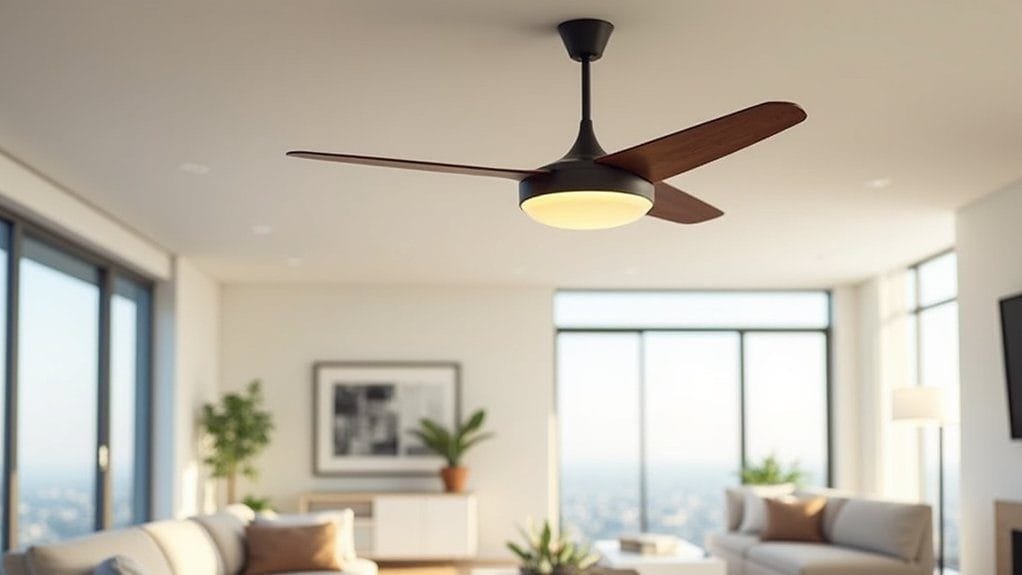
Though technology continues to transform home comfort solutions, Hunter’s smart ceiling fans stand out for their thorough integration of cutting-edge features. You’ll appreciate their advanced control mechanisms, including voice commands compatible with Alexa and Google Assistant, plus extensive remote control functionality. The fans deliver superior energy efficiency through multiple speed settings and reversible motor technology, enabling year-round performance optimization.
Installation remains remarkably straightforward, with standard mounting options accommodating various ceiling heights and room dimensions. Smart ceiling fans from Hunter offer dimmable LED lighting, enhancing both functional illumination and aesthetic appeal. Significantly, these fans present an attractive price range that makes sophisticated home climate management accessible, bridging the gap between high-end models and budget-conscious consumers seeking intelligent home cooling solutions.
Haiku Smart Ceiling Fan Capabilities
Building upon Hunter’s innovative smart fan technology, Haiku elevates home cooling with its advanced sensor-driven capabilities. The Haiku Smart Ceiling Fan delivers extensive functionality through Generation 4 technology, integrating seamlessly with smart home systems like Alexa and Google Assistant. Its advanced onboard sensors enable precise motion detection and scheduling, optimizing air circulation in large rooms with remarkable energy efficiency.
You’ll appreciate the fan’s unique “Whoosh mode,” which simulates natural breezes by dynamically varying fan speed for enhanced comfort. Designed for professional installation, the fan can broadcast Wi-Fi signals, ensuring easy connectivity across multiple units. With its dedicated iOS and Android app, you’ll enjoy extensive voice control and intuitive management of your home’s cooling environment, making the Haiku Smart Ceiling Fan a sophisticated solution for modern living spaces.
Price and Value Comparison

While comparing smart ceiling fan options, price emerges as a critical factor for consumers evaluating large room cooling solutions. Haiku fans command a higher price point, starting at $450 and reaching up to $1,600 for models with advanced features, whereas Hunter fans offer budget-friendly options generally priced below $400. Your decision should balance initial cost against long-term value.
Haiku’s premium pricing reflects superior technology like motion sensing and climate control integration, coupled with strong customer support and extended warranty coverage. Hunter fans provide basic functionality at a more accessible price. When reviewing value, consider not just upfront costs but potential long-term reliability and performance. Your specific room requirements, technical preferences, and budget will ultimately guide your selection between these two smart ceiling fan brands.
Installation and Setup Requirements
After weighing the financial investment of smart ceiling fans, homeowners must next consider the technical complexities of installation and setup. When comparing Haiku and Hunter fans, several key installation factors emerge:
- Haiku fans require professional installation to guarantee peak safety and performance
- Hunter fans typically support more straightforward DIY installation processes
- Haiku’s new wall controllers can be easily integrated into standard light switch receptacles
- Each Haiku fan broadcasts its own Wi-Fi signal, facilitating simplified app connection
- Installation time varies, with Haiku setups potentially taking several hours depending on complexity
Smart fans like Haiku and Hunter offer distinct installation approaches. While Haiku prioritizes professional setup and advanced connectivity, Hunter fans emphasize user-friendly installation strategies. The choice ultimately depends on your technical comfort level and desired smart home integration.
Smart Home Integration
How seamlessly can smart ceiling fans integrate into your existing home automation ecosystem? Haiku fans offer robust smart home integration with direct compatibility for Alexa and Google Assistant, enabling extensive voice control. Their Haiku Home app provides advanced features like motion detection programming and scheduling, enhancing overall connectivity. Hunter fans can also integrate with smart switches and home systems, though their app capabilities might be less sophisticated.
When evaluating smart home performance, Haiku’s Generation 4 technology guarantees reliable connectivity and responsive app control. While Hunter fans are more budget-friendly, Haiku provides superior customer service and warranty support. Your choice should depend on balancing smart functionality, technological sophistication, and long-term value in your home automation strategy.
Energy Efficiency and Sensor Technology
Smart home integration sets the stage for exploring how ceiling fans can do more than simply circulate air—they can now optimize energy consumption through advanced sensor technologies. When comparing Haiku and Hunter fans, you’ll discover significant differences in energy efficiency and smart capabilities:
- Haiku fans feature onboard sensors for motion detection and climate optimization
- Energy Star certification validates Haiku’s superior energy performance
- Advanced “Whoosh mode” simulates natural breezes for efficient air circulation
- Integrated Ecobee thermostat compatibility enhances overall HVAC efficiency
- Sensor technology enables precise room-specific temperature and occupancy adjustments
These technological innovations transform traditional ceiling fans into intelligent devices that dynamically manage energy consumption. By leveraging sophisticated sensor technology, Haiku fans provide a more adaptive and energy-efficient cooling solution for large rooms, setting a new standard in smart fan performance.
Real-World User Experience and Reviews
As consumers increasingly seek intelligent home solutions, real-world experiences with Haiku and Hunter smart ceiling fans reveal nuanced performance metrics beyond manufacturer specifications.
| Hunter Fans | Haiku Fans |
|---|---|
| Budget-friendly | Advanced features |
| Reliable cooling | Superior climate control |
| Standard performance | Smart home integration |
| Cost-effective | Premium user experience |
User testimonials demonstrate that while Hunter fans deliver consistent cooling at under $400, Haiku fans justify their higher price point through sophisticated sensor technology and innovative features like “Whoosh mode”. Customers consistently praise Haiku’s motion sensing capabilities and thorough app integration, which transform ceiling fans from basic cooling devices into intelligent home climate management systems. Hunter fans remain competitive for budget-conscious consumers, but Haiku’s advanced features and exceptional customer support make them particularly attractive for tech-savvy homeowners seeking extensive smart home solutions in large room environments.
Frequently Asked Questions
Is a 52 Inch Fan Too Big for a 12X12 Room?
You’ll find a 52-inch fan’s likely too large for your 12×12 room. Consider a 36-42 inch model instead, which optimizes airflow efficiency, minimizes noise, and guarantees proper installation without overwhelming the space’s aesthetic and energy dynamics.
What Is the Difference Between Haiku and Haiku L?
Like a Swiss Army knife versus a standard blade, the Haiku fan offers advanced SenseMe technology, superior design, and smart features, while the Haiku L provides a more basic, budget-friendly option with simplified Haiku performance and reduced energy capabilities.
What Size Ceiling Fan for a Large Room?
You’ll need a 52-62 inch fan for large rooms over 224 sq ft, ensuring ideal airflow efficiency, considering ceiling height, design aesthetics, and installation requirements while minimizing noise and maximizing energy performance.
Which Company Is Better for Ceiling Fans?
Ever wondered which ceiling fan reigns supreme? You’ll find Hunter offers reliable quality, while Haiku brings innovative design. Consider fan efficiency, aesthetics, and price. Your choice depends on prioritizing durability, smart features, noise levels, and extensive warranty coverage.
Conclusion
When choosing between Hunter and Haiku smart ceiling fans for large rooms, your decision hinges on precise performance metrics. Both brands offer cutting-edge technology, but nuanced differences emerge in sensor responsiveness, energy efficiency, and smart home compatibility. Your ultimate selection will depend on balancing technological sophistication with practical room-specific cooling requirements and budget constraints. Each fan represents a sophisticated approach to intelligent climate management.