
When comparing Jetboil and MSR backpacking stoves, you’ll find nuanced trade-offs. Jetboil’s Flash offers rapid 100-second boil times and compact design, while MSR’s Windburner delivers superior wind resistance and reliability. Your choice depends on prioritizing speed versus performance in challenging conditions. The Stash model provides remarkable weight efficiency at 7.1 oz, challenging both competitors. Weight, boil time, and environmental adaptability will determine your ideal stove—and there’s more to unpack in this technical comparison.
Key Takeaways
- Jetboil Stash offers the lightest weight at 7.1 oz, making it ideal for ultralight backpackers seeking minimal pack weight.
- MSR Windburner provides superior wind performance, boiling water efficiently in challenging outdoor conditions with consistent fuel flow.
- Boil times vary significantly, with Jetboil Flash achieving fastest results at 100 seconds versus Windburner’s 2.25 minutes.
- Fuel efficiency differs across models, with Jetboil Stash leading at 12 liters per 100g, offering economic long-distance cooking performance.
- Price points range from $50-$150, with MSR PocketRocket 2 as a budget option and Windburner providing premium wind-resistant features.
Stove System Design and Components
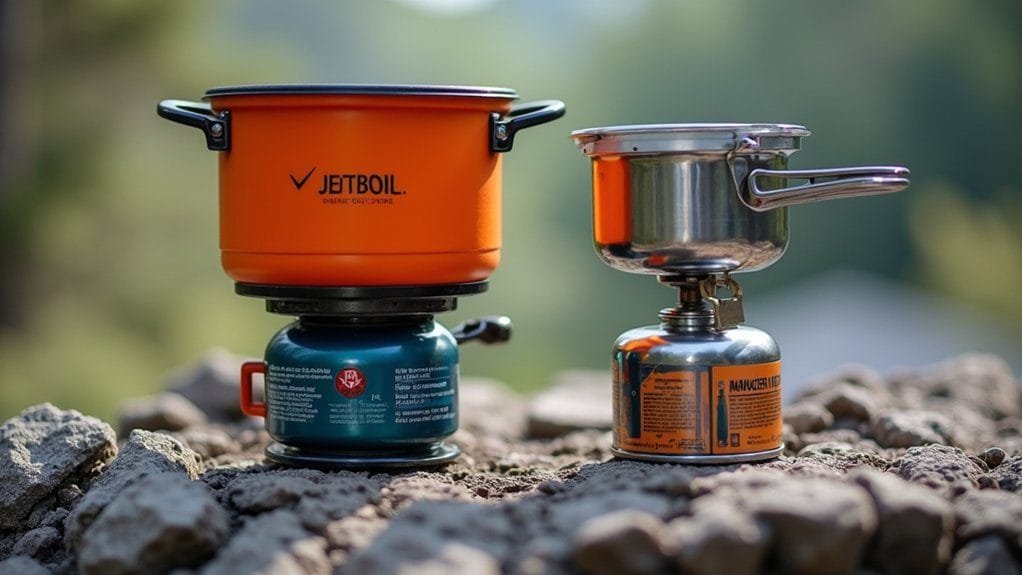
While backpacking stove systems have evolved considerably in recent years, two leading manufacturers—Jetboil and MSR—demonstrate distinct approaches to portable cooking technology. Jetboil‘s integrated design combines the cooking pot and stove into a single, compact unit, prioritizing rapid boil times and streamlined functionality. In contrast, MSR’s Windburner and PocketRocket offer modular systems that allow you to customize your backpacking stove setup with separate components.
The core difference lies in their engineering philosophies: Jetboil emphasizes all-in-one efficiency, with models like the Flash boiling water in just 100 seconds, while MSR focuses on versatility and wind resistance. Both manufacturers engineer their stoves to maximize fuel efficiency and minimize weight, critical considerations for serious backpackers seeking lightweight, reliable cooking solutions in challenging outdoor environments.
Performance in Challenging Environments
Because outdoor performance can make or break a backpacking stove’s utility, the MSR Windburner and Jetboil Flash reveal stark differences when confronted with challenging environmental conditions. When you’re boiling water in windy situations, the Windburner outperforms the Jetboil Flash, maintaining a remarkable 2:40 boil time compared to the Flash’s 5:58. Its enclosed burner system provides superior fuel efficiency, consuming only 0.3 oz of fuel in 10 mph winds versus the Flash’s 0.5 oz. You’ll appreciate the Windburner’s reliability in cold weather, where the Jetboil Flash struggles with fuel flow issues. At high altitudes and varying temperatures, these backpacking stoves demonstrate that design fundamentally impacts performance, with the MSR Windburner consistently delivering more dependable results across challenging conditions.
Weight and Packability Considerations
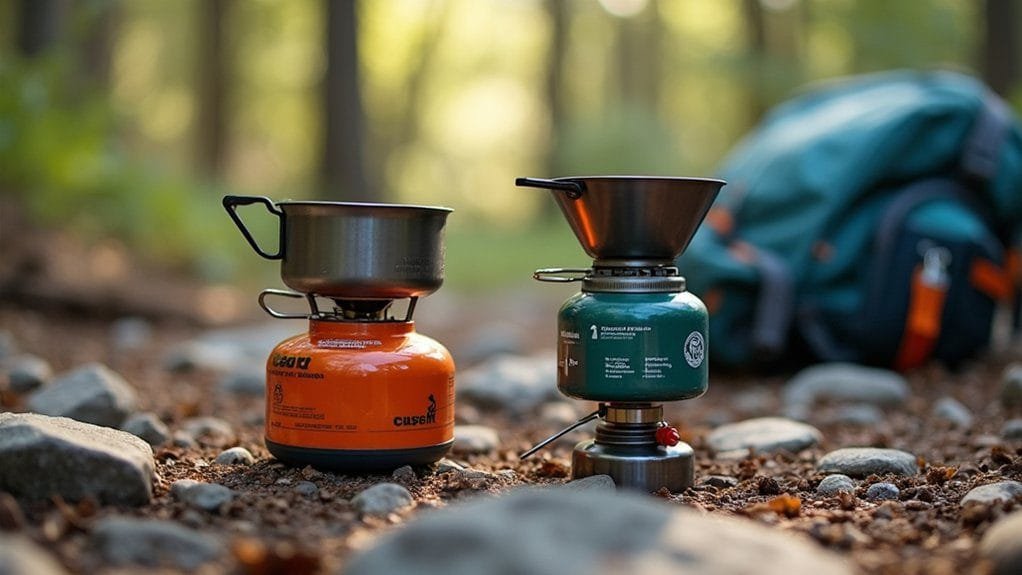
When evaluating backpacking stoves, weight and packability emerge as critical factors that can greatly impact a hiker’s mobility and comfort. The Jetboil Stash stands out with its remarkably lightweight 7.1 oz design, offering significant weight savings compared to the Flash (13.1 oz) and MSR Windburner (15.5 oz). Its compact 5.1 x 4.4-inch profile guarantees efficient packing, making it ideal for long-distance hikes where every ounce matters.
| Stove Model | Weight | Capacity |
|---|---|---|
| Jetboil Stash | 7.1 oz | 27 fl oz |
| Jetboil Flash | 13.1 oz | 32 fl oz |
| MSR Windburner | 15.5 oz | 32 fl oz |
With superior fuel efficiency of 12 L per 100g, the Stash proves that a packable stove can deliver performance without unnecessary weight penalties.
Boil Time and Fuel Efficiency Comparison
How do backpacking stoves stack up when it comes to performance under pressure? The Jetboil Flash emerges as a top performer with an impressive 100-second boil time for 0.5 liters, making it a standout in ultralight gear. In contrast, the MSR Windburner takes 2.25 minutes to boil the same volume, compensating with superior wind resistance. The Jetboil Stash lags behind at 2.5 minutes, challenging its competitive edge.
Fuel efficiency tells another part of the story. The Jetboil Stash leads with 12 liters per 100g of fuel, outperforming the Flash at 10 liters and the Windburner at 8.2 liters. When you’re selecting an integrated canister stove for backcountry cooking, these metrics matter. Your choice depends on balancing boil times, wind performance, and fuel consumption.
Price Point and Value Analysis
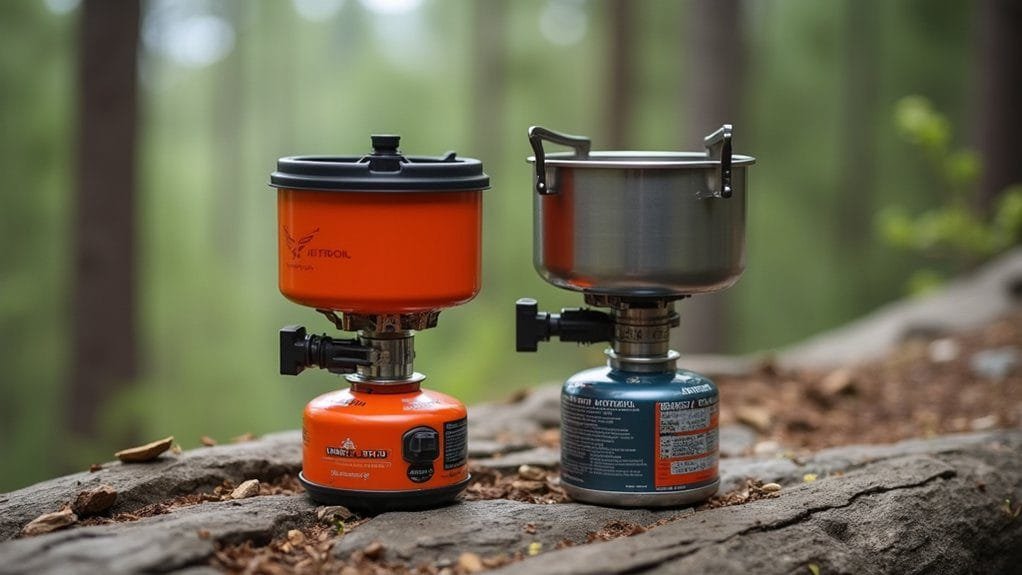
Performance metrics like boil time and fuel efficiency paint only part of the backpacking stove selection picture—price and overall value demand equal scrutiny. When comparing the Jetboil Flash at $99.95 and the MSR Windburner at $149.95, you’ll find nuanced value propositions beyond raw cost. The Jetboil Flash offers an integrated all-in-one system with fast boiling capabilities, potentially justifying its price through convenience and performance. Conversely, the MSR Windburner’s wind-resistant features provide exceptional performance in challenging environments, enhancing its cost-performance ratio.
The MSR PocketRocket 2, crowned best overall canister stove at $50, and the Soto Amicus Stove Cookset Combo represent budget-conscious alternatives. Your ultimate selection should balance initial investment against long-term utility, considering your specific backcountry cooking requirements and environmental conditions.
User Experience and Ease of Use
Because ease of use can make or break a backcountry cooking experience, backpackers prioritize intuitive design and functional simplicity when selecting a portable stove. The Jetboil Flash offers rapid water boiling in 100 seconds, with a compact 7.1 x 4.1-inch profile that enhances user experience through efficient packing. Conversely, the MSR Windburner provides superior stability with its locking pot mechanism, which minimizes tipping risks during outdoor cooking.
While the Flash features a piezo igniter that can be unreliable, requiring backup ignition methods, the Windburner demands manual ignition but delivers consistent performance. The Windburner’s windproof design greatly improves cooking efficiency, making it more adaptable in challenging environments. Both stoves accommodate standard fuel canisters, but the Windburner’s advanced engineering provides a more robust solution for demanding backcountry scenarios.
Recommendations for Different Outdoor Scenarios
While selecting the ideal backpacking stove depends on specific outdoor scenarios, backpackers can strategically match stove characteristics to their anticipated trip conditions. For fast-paced trips with minimal cooking needs, the Jetboil Flash‘s rapid 100-second boil time and lightweight 13.1 oz design make it advantageous for quick water heating. Conversely, when facing extreme weather, the MSR Windburner‘s superior windproof performance and exceptional 8.2 L per 100g fuel efficiency become critical for sustained outdoor adventures. If your journey involves diverse cooking requirements, the Jetboil Flash offers more versatility, while extended expeditions might benefit from the Windburner’s reliable boiling capabilities. Your choice should ultimately balance weight, performance, fuel efficiency, and specific environmental challenges to secure the most fitting backpacking stove for your unique outdoor experience.
Frequently Asked Questions
Can I Use Alternative Fuel Types With These Backpacking Stoves?
You’ll find limited alternative fuel compatibility with these stoves. Most models require specific isobutane-propane canisters, though some offer adapter kits for alcohol or white gas. Consider performance, efficiency, and weight when exploring alternative fuel options.
How Durable Are Jetboil and MSR Stoves in Extreme Weather Conditions?
You’ll find both Jetboil and MSR stoves remarkably resilient in extreme conditions, with robust material quality and design innovations ensuring wind resistance and fuel efficiency across challenging temperatures and terrain.
Are These Stoves Compatible With International Camping and Hiking Destinations?
Ever wondered how your stove might adapt globally? Both Jetboil and MSR offer international compatibility with versatile fuel types, meeting travel regulations while ensuring cooking efficiency and safety across diverse hiking environments.
What Maintenance Is Required to Keep These Stoves in Optimal Condition?
You’ll need to clean your stove regularly, store fuel properly, maintain seals, inspect burners and ignition systems, check pot supports, replace hoses periodically, test valve functionality, and conduct performance evaluations to guarantee peak stove condition and reliability.
Can These Stoves Be Safely Used Inside a Tent During Emergencies?
You’ll want to avoid using stoves inside tents due to critical carbon monoxide risks. Emergency situations demand alternative heating methods that prioritize ventilation and minimize fire hazards, ensuring your survival gear doesn’t become a life-threatening liability.
Conclusion
When you’re choosing between Jetboil and MSR, think of it like picking your adventure sidekick. Both stoves are trail-tested warriors, but your perfect match depends on your specific terrain and needs. Whether you’re a weight-conscious ultralight hiker or a basecamp gourmet, one of these compact cooking companions will fuel your wilderness journeys, turning mountain meals from mere sustenance into memorable culinary moments.