
When battling basement moisture, you’ll find Frigidaire’s dehumidifier outperforms Homelabs. It consumes less power (570 watts vs. 610 watts), operates more quietly (52.9 dB vs. 59.3 dB), and offers superior build quality. With a larger 2.64-gallon reservoir and robust design, Frigidaire provides more consistent humidity control. Its Energy Star certification and advanced features make it the top choice for reliable basement moisture management. Uncover the nuanced differences that set this powerhouse apart.
Key Takeaways
- Frigidaire offers superior performance in basement moisture control with higher extraction rates and more consistent energy efficiency compared to Homelabs.
- Noise levels favor Frigidaire, operating at a quieter 52.9 dB versus hOmeLabs’ 59.3 dB, ensuring a more comfortable basement environment.
- Build quality and design distinguish Frigidaire, featuring a larger 2.64-gallon water reservoir and more robust construction compared to hOmeLabs’ lighter plastic components.
- Warranty and customer support are significantly stronger with Frigidaire, providing comprehensive coverage and a more reliable service network for maintenance and repairs.
- Advanced features like better humidity control settings, smart technology integration, and superior control panel clarity make Frigidaire the recommended choice for basement dehumidification.
Performance Metrics: Power Consumption and Efficiency
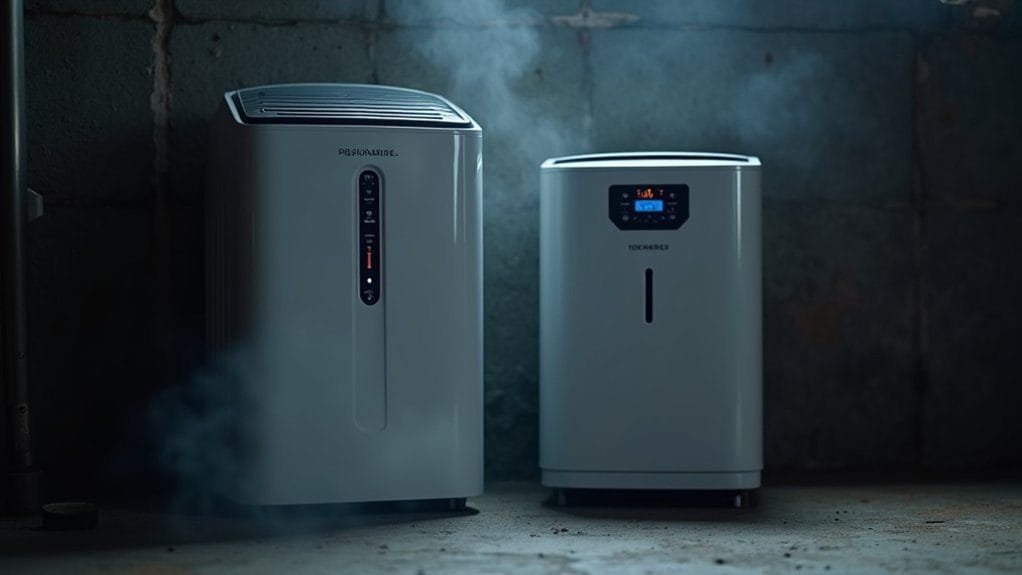
When evaluating dehumidifiers for basement moisture control, power consumption and efficiency stand as essential performance metrics. The hOmeLabs and Frigidaire models demonstrate distinct energy efficiency characteristics. At 50% relative humidity, the hOmeLabs dehumidifier consumes 610 watts, while the Frigidaire unit draws approximately 570 watts, highlighting the Frigidaire’s lower power consumption advantage. Both units are Energy Star certified, indicating superior efficiency standards. At higher humidity levels, both dehumidifiers converge to around 760 watts, revealing consistent performance. The hOmeLabs model features an energy efficiency rating of 4.0, but the Frigidaire’s reduced wattage makes it the more efficient choice. For basement moisture management, these performance metrics provide essential insights into selecting a prime, energy-conscious dehumidifier.
Noise Levels and Operational Experience
Because noise levels greatly impact user satisfaction, basement dehumidifiers must be evaluated not just by their moisture removal capabilities, but also by their acoustic performance. When comparing hOmeLabs and Frigidaire units, noise profiles reveal critical operational differences. The hOmeLabs model generates 59.3 dB on high speed with a buzzing sound that users find intrusive, while Frigidaire offers a more pleasant noise profile at 52.9 dB. At 10 feet, hOmeLabs registers 50.3 dB on high speed and 48.8 dB on low speed, marginally quieter but with performance challenges. Operational experience suggests Frigidaire’s sound quality contributes greatly to user preference, despite slightly higher decibel measurements. Performance malfunctions in hOmeLabs can further escalate noise levels, making the Frigidaire a more consistently comfortable basement dehumidification solution.
Design and Build Quality Comparison
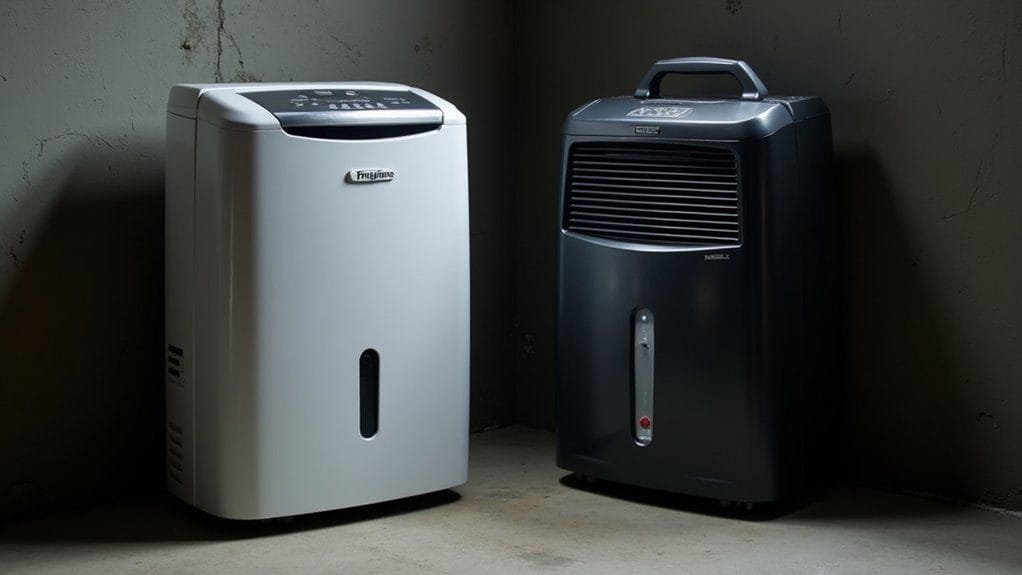
Although design and build quality are essential factors in selecting a basement dehumidifier, the Frigidaire and hOmeLabs units present markedly different approaches to construction and durability. The Frigidaire’s robust design features a sturdy 2.64-gallon water reservoir with a splash guard, ensuring minimal spillage during tank removal. Its control panel boasts a sleek LED display, enhancing user interaction. Conversely, hOmeLabs utilizes thinner plastic components, resulting in a lighter 40-lb unit but potentially compromising long-term durability. While hOmeLabs’ design prioritizes portability, Frigidaire emphasizes structural integrity. The water tank capacity diverges considerably, with Frigidaire offering 16.9 pints compared to hOmeLabs’ smaller reservoir. Users will find the Frigidaire’s construction more reliable, with superior build quality that translates to enhanced performance and longevity in basement environments.
Features and User-Friendly Controls
In the competitive landscape of basement dehumidifiers, control features and user interface distinguish top-tier models like Frigidaire and hOmeLabs. You’ll appreciate the Frigidaire’s digital display and customizable moisture controls, which allow precise humidity management. The hOmeLabs unit offers a humidistat adjustable in 5% increments and a 24-hour timer for flexible operation.
| Feature | Frigidaire | hOmeLabs |
|---|---|---|
| Drainage | Continuous (garden hose) | Standard |
| Reservoir | 2.64-gallon | Lightweight |
| Maintenance | Superior controls | Filter light reminder |
Both models provide automatic shut-off functionality and user-friendly interfaces. The Frigidaire stands out with its superior control panel clarity, while hOmeLabs offers convenient maintenance indicators. When selecting a dehumidifier, consider these nuanced features that enhance your basement’s moisture control experience.
Warranty and Customer Support
Beyond the intuitive controls and user-friendly interfaces, the warranty and customer support landscape reveals significant distinctions between Frigidaire and hOmeLabs dehumidifiers. When evaluating long-term reliability, Frigidaire emerges as the superior choice. Their established brand reputation guarantees robust customer support and consistent warranty service. While hOmeLabs offers a 1-year warranty extendable to 2 years, their relatively new market presence and inconsistent user experiences undermine their credibility.
Frigidaire’s customer support consistently receives positive feedback, with users reporting efficient warranty claims and responsive service. In contrast, hOmeLabs struggles with inadequate customer support, potentially compromising your investment. For basement dehumidifier buyers prioritizing dependable service and thorough warranty coverage, Frigidaire represents the more trustworthy option, providing peace of mind through proven brand performance and reliable customer support.
Price Point and Value Proposition
A meticulous comparison of basement dehumidifier pricing reveals nuanced trade-offs between hOmeLabs and Frigidaire models. You’ll find hOmeLabs offers a compelling price point approximately $50 lower than Frigidaire, making it an attractive budget-friendly option. However, the value proposition extends beyond initial cost.
Frigidaire’s higher price reflects superior reliability, durability, and more robust moisture removal capabilities. Its larger tank capacity and superior build quality justify the investment for discerning consumers. While hOmeLabs provides a basic one-to-two-year warranty, Frigidaire’s established market reputation suggests longer-term performance and dependability.
When evaluating overall value, consider not just upfront expenses but potential long-term benefits. Frigidaire’s reputation for consistent performance might offset its higher initial price, making it a potentially more economical choice for extensive basement moisture management.
Technical Specifications Breakdown
Moving from price considerations to performance metrics, technical specifications reveal the true capabilities of basement dehumidifiers. When comparing Frigidaire and hOmeLabs, you’ll find distinct differences in moisture removal rate and energy efficiency. The Frigidaire model extracts 60 pints daily versus hOmeLabs’ 50 pints, with a more energy-efficient 570-watt consumption compared to hOmeLabs’ 610 watts. Its 2.64-gallon water reservoir offers slightly more capacity, reducing emptying frequency. Noise output further distinguishes these units, with Frigidaire operating at a quieter 52.9 dB versus hOmeLabs’ 59.3 dB. A critical feature for basement humidity control is the continuous drain option, which Frigidaire provides through a standard garden hose fitting—a capability absent in the hOmeLabs unit, potentially limiting drainage flexibility in challenging basement environments.
Real-World Testing and Long-Term Reliability
While laboratory specifications provide initial insights, real-world performance ultimately determines a dehumidifier’s effectiveness in basement environments. Rigorous testing reveals Frigidaire’s superior moisture removal capabilities, extracting 22.3 pints in four hours compared to hOmeLabs’ 9.4 pints. The Frigidaire unit demonstrates considerably higher reliability, with a robust construction featuring a durable water reservoir that outperforms hOmeLabs’ budget-grade materials. Customer experiences highlight recurring mechanical failures and icing issues with hOmeLabs, raising concerns about long-term performance. Frigidaire’s established presence in the dehumidifier market suggests more dependable warranty support and customer service. When selecting a basement dehumidifier, you’ll want to prioritize consistent moisture control and proven reliability—factors where Frigidaire clearly distinguishes itself from the competition.
Frequently Asked Questions
What Is the Most Reliable Basement Dehumidifier?
You’ll want a Frigidaire dehumidifier for top-tier moisture control. It’s energy-efficient, handles high humidity levels, and boasts superior air quality with reliable portable units. Consider its capacity ratings, low noise, and proven performance in basement environments.
Which Is Better Homelabs or Frigidaire Dehumidifier?
You’ll find Frigidaire outperforms hOmeLabs with superior moisture removal, energy efficiency, and reliability. Consider its larger capacity, robust construction, and user-friendly features when choosing a basement dehumidifier, despite the slightly higher initial investment.
What Brand Is Best for Dehumidifiers?
Like a moisture-sapping knight, Frigidaire conquers humidity battles. You’ll want its top-tier energy efficiency, robust features, and proven reliability. Consider size, noise levels, and warranty when selecting your dehumidifier for ideal indoor humidity control.
What Is the Best Home Made Dehumidifier?
You’ll find rock salt, silica gel, and charcoal briquettes are your best DIY dehumidifier options. They’re cost-effective, environmentally friendly, and efficiently absorb moisture. Strategic placement and regular maintenance guarantee peak performance in damp spaces.
Conclusion
When choosing between Frigidaire and Homelabs dehumidifiers, you’ll find each offers unique strengths for basement moisture control. Your decision hinges on balancing performance, efficiency, and budget. The right unit can transform your damp basement into a desert-dry sanctuary, eliminating musty odors and preventing potential mold growth. Ultimately, both brands deliver reliable moisture management, so select the model that best matches your specific environmental needs and technical requirements.