
Infrared heaters warm your space faster than ceramic models, delivering instant radiant heat directly to objects. You’ll experience near-instantaneous temperature rise as infrared technology emits energy with 100% efficiency, bypassing traditional air-warming methods. Ceramic heaters rely on slower convection processes, creating gradual temperature increases. The difference is notable: infrared provides immediate warmth, while ceramic heaters take longer to reach desired temperatures. Stick around to unpack the full thermal performance spectrum.
Key Takeaways
- Infrared heaters deliver immediate radiant heat directly to objects and people, warming spaces much faster than ceramic heaters’ convection-based heating method.
- Ceramic heaters rely on gradually warming air through fans, resulting in slower heat distribution and longer time to reach desired temperatures.
- Infrared technology emits radiation instantaneously, providing near-immediate warmth upon activation, compared to ceramic heaters’ slower heat generation process.
- Radiant heat from infrared heaters penetrates objects directly, creating a more rapid warming effect than ceramic heaters’ indirect air circulation approach.
- Energy efficiency metrics demonstrate infrared heaters’ superior heating speed, with almost 100% direct energy conversion versus ceramic heaters’ more gradual and energy-consuming warming technique.
Understanding Ceramic Heaters
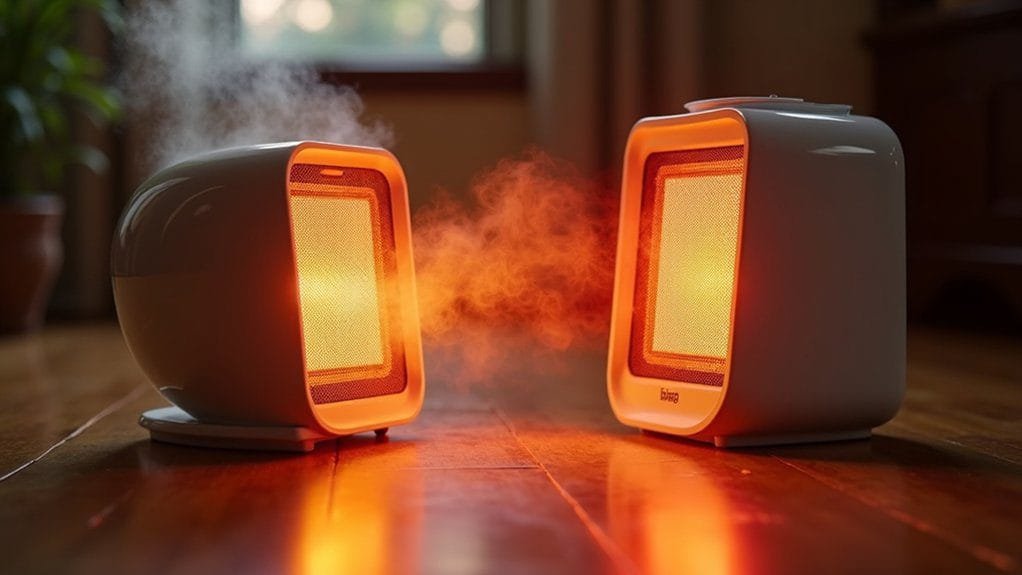
Warmth whispers through ceramic heating technology, delivering targeted comfort in compact spaces. Ceramic heaters utilize a specialized heating element that generates warmth through convection, efficiently raising ambient temperatures. You’ll find these portable devices particularly useful as supplemental heating sources, with prices ranging from $30 to $150, making them an affordable solution for localized climate control.
Two primary variations exist: standard models and fan-aided models. The latter distribute warm air more evenly, compensating for the inherent slow warm-up time. Critical safety features like overheat protection and tip-over switches enhance reliability, ensuring you can confidently operate these devices in home environments.
While not intended as primary heating systems, ceramic heaters excel in smaller spaces, offering precise, targeted warmth with minimal energy consumption.
Exploring Infrared Heating Technology
Building upon our exploration of ceramic heating solutions, infrared technology represents a sophisticated alternative that radically reimagines thermal energy transfer. Infrared heaters deliver immediate warmth by emitting radiation that directly warms objects and people, not the surrounding air. You’ll experience nearly 100% energy efficiency as these devices convert electrical energy into radiant heat, minimizing energy waste. The heating speed is remarkable—you’ll feel warmth almost instantly upon activation. Unlike traditional systems, infrared heaters provide consistent heat distribution without problematic hot and cold spots. Furthermore, they maintain natural humidity levels, making them particularly beneficial for individuals with respiratory issues. By leveraging advanced heat transfer principles, infrared heating technology offers a precise, efficient warming solution that prioritizes both performance and air quality.
Heating Speed Comparison
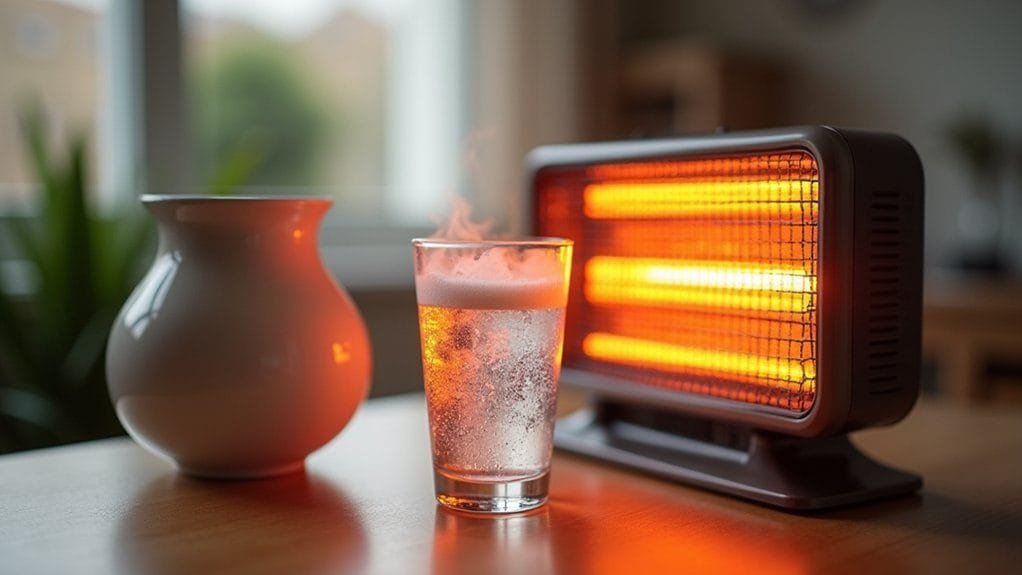
When comparing heating technologies, speed emerges as a critical performance metric that directly impacts user comfort and energy efficiency. Infrared heaters excel in rapid heating, delivering immediate warmth by directly heating objects and people with superior heat transfer speed. You’ll notice these heaters can warm a room in minutes, contrasting sharply with ceramic heaters that rely on convection heating and take considerably longer to reach desired temperatures.
The key difference lies in their heating mechanism: infrared technology emits radiant heat instantaneously, while ceramic heaters gradually warm surrounding air, potentially experiencing energy loss. If quick warmth is your priority, infrared heaters provide a more efficient solution, ensuring you experience immediate comfort with minimal waiting time and maximum thermal performance.
Energy Efficiency Analysis
Beyond rapid heating performance, energy efficiency stands as a paramount consideration in heater selection. When comparing infrared and ceramic heating systems, you’ll discover significant disparities in operational costs and long-term energy savings. Infrared heaters achieve nearly 100% energy efficiency by directly heating objects, eliminating energy waste associated with traditional heating elements. Your upfront investment ranges from $100 to $600, but you’ll recoup costs through reduced electricity consumption—typically $0.06 to $0.36 per hour.
Ceramic heaters, conversely, consume more energy due to fan operation and convection heating mechanisms. While their initial purchase price is lower, you’ll experience higher running expenses. Infrared technology provides immediate warmth without compromising indoor humidity levels, making them a more sophisticated, energy-conscious heating solution for discerning consumers.
Cost and Performance Breakdown
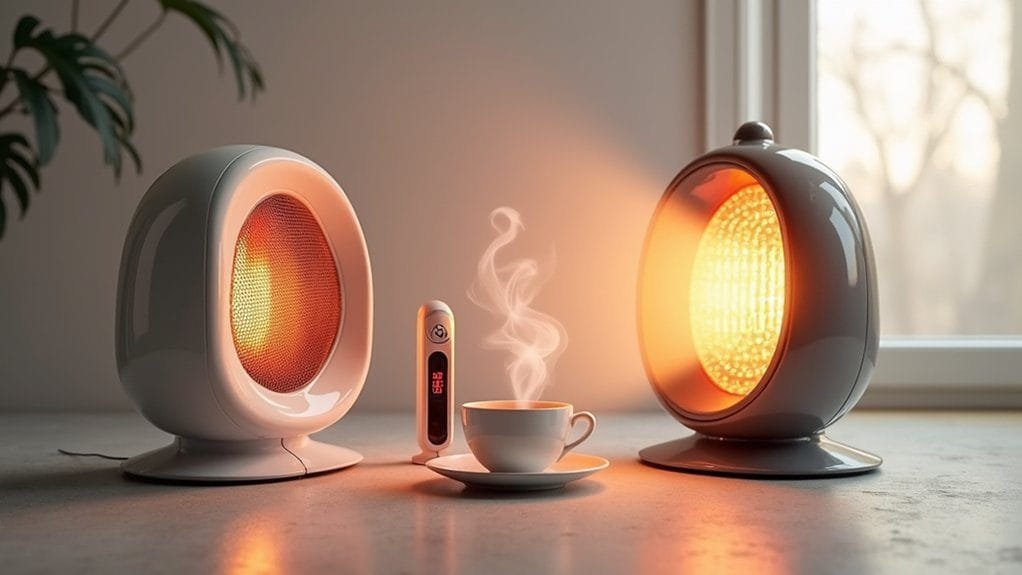
While cost and performance metrics reveal critical distinctions between ceramic and infrared heaters, a thorough analysis illuminates their comparative strengths and limitations. Ceramic heaters present a more budget-friendly initial investment, ranging from $30 to $150, making them attractive for quick warmth in smaller spaces. Infrared heaters, with higher upfront costs between $100 and $600, offer more effective heating solutions through direct object warming. Energy consumption reveals further nuance: infrared options operate more economically at $0.06 to $0.36 per hour, demonstrating superior long-term efficiency. When evaluating performance, infrared heaters excel by providing consistent heat immediately, whereas ceramic heaters require time to warm surrounding air. Your choice depends on space requirements, budget constraints, and desired heating characteristics.
Health and Safety Considerations
Although home heating solutions prioritize warmth, health and safety considerations emerge as critical factors when selecting between ceramic and infrared heaters. If you’re concerned about respiratory health, infrared heaters offer superior air quality by avoiding dust and allergen circulation. Ceramic heaters, with their fan-based systems, might exacerbate respiratory issues by stirring up particles.
Both heater types incorporate essential safety features like automatic shut-off mechanisms and tip-over switches, mitigating potential fire risks. However, infrared heaters provide additional comfort through silent operation, eliminating disruptive fan noise. Ceramic heaters demand more caution, as their exposed heating elements can pose burn risks during operation.
When evaluating your heating solution, prioritize not just warmth, but the holistic impact on your living environment’s health and safety profile.
Choosing the Right Heater for Your Space
How do you select the ideal heating solution for your specific spatial requirements? Your choice between ceramic and infrared heaters depends on space size, efficiency needs, and comfort preferences.
| Heater Type | Best For | Efficiency |
|---|---|---|
| Ceramic | Small Rooms | Moderate |
| Infrared | Large/Open Spaces | High |
| Convection | Consistent Heating | Low-Moderate |
| Radiant | Immediate Comfort | High |
Infrared heaters excel in larger spaces, providing immediate warmth by directly heating objects and people. They’re energy-efficient and cost-effective, reducing heating bills despite higher initial investments. Ceramic heaters work well in compact areas, utilizing convection to warm air. When prioritizing quiet environments, infrared models operate silently, unlike ceramic heaters with fans. Consider your specific spatial dynamics, desired warmth distribution, and long-term energy consumption when selecting between these heating technologies.
Frequently Asked Questions
Which Heats Better, Infrared or Ceramic?
You’ll find infrared heaters heat better overall, delivering instant warmth with superior energy efficiency, ideal for larger spaces, while ceramic heaters provide slower, more gradual comfort—your choice depends on specific room size and heating needs.
What Type of Heater Heats the Fastest?
Like a lightning bolt of warmth, infrared heaters blaze past ceramic models, delivering near-instantaneous heat with superior efficiency. They’ll provide rapid, direct heating while optimizing energy consumption and meeting diverse user preferences more quickly.
What Are the Disadvantages of Infrared Heating?
You’ll face challenges with infrared heaters: higher installation costs, limited room coverage, potential uneven heating, and focused warmth that mightn’t suit everyone’s comfort preferences, while also experiencing higher initial investment compared to traditional heating solutions.
What Are the Cons of Ceramic Heaters?
Did you know ceramic heaters consume up to 30% more energy? You’ll face challenges with limited ceramic efficiency, noisy operation, slower heating capacity, higher maintenance costs, and restricted temperature customization compared to alternative heating solutions.
Conclusion
When it comes to heating your space, understanding the nuanced performance of ceramic and infrared heaters is essential. Like a strategic chess match of thermal technology, your choice hinges on specific environmental factors. Ceramic heaters offer rapid, targeted warmth, while infrared models provide efficient, penetrating heat. Your best selection depends on room size, insulation, and personal comfort preferences—a precise thermal calculus determining your heating strategy’s ultimate effectiveness.